


Page 336 - PRINCIPLES OF QUANTUM MECHANICS as Applied to Chemistry and Chemical Physics
P. 336
Series solutions of differential equations 327
1
X ks1
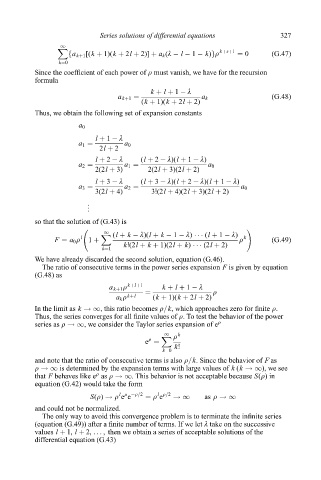
fa k1 [(k 1)(k 2l 2)] a k (ë ÿ l ÿ 1 ÿ k)gr 0 (G:47)
k0
Since the coef®cient of each power of r must vanish, we have for the recursion
formula
k l 1 ÿ ë
a k1 a k (G:48)
(k 1)(k 2l 2)
Thus, we obtain the following set of expansion constants
a 0
l 1 ÿ ë
a 1 a 0
2l 2
l 2 ÿ ë (l 2 ÿ ë)(l 1 ÿ ë)
a 2 a 1 a 0
2(2l 3) 2(2l 3)(2l 2)
l 3 ÿ ë (l 3 ÿ ë)(l 2 ÿ ë)(l 1 ÿ ë)
a 3 a 2 a 0
3(2l 4) 3!(2l 4)(2l 3)(2l 2)
.
.
.
so that the solution of (G.43) is
!
1
X (l k ÿ ë)(l k ÿ 1 ÿ ë) (l 1 ÿ ë)
F a 0 r l 1 r k (G:49)
k!(2l k 1)(2l k) (2l 2)
k1
We have already discarded the second solution, equation (G.46).
The ratio of consecutive terms in the power series expansion F is given by equation
(G.48) as
a k1 r kl1 k l 1 ÿ ë
r
a k r kl (k 1)(k 2l 2)
In the limit as k !1, this ratio becomes r=k, which approaches zero for ®nite r.
Thus, the series converges for all ®nite values of r. To test the behavior of the power
series as r !1, we consider the Taylor series expansion of e r
1 r k
r X
e
k!
k0
and note that the ratio of consecutive terms is also r=k. Since the behavior of F as
r !1 is determined by the expansion terms with large values of k (k !1), we see
r
that F behaves like e as r !1. This behavior is not acceptable because S(r)in
equation (G.42) would take the form
l r=2
l r ÿr=2
S(r) ! r e e r e !1 as r !1
and could not be normalized.
The only way to avoid this convergence problem is to terminate the in®nite series
(equation (G.49)) after a ®nite number of terms. If we let ë take on the successive
values l 1, l 2, ... , then we obtain a series of acceptable solutions of the
differential equation (G.43)

