Page 333 - PRINCIPLES OF QUANTUM MECHANICS as Applied to Chemistry and Chemical Physics
P. 333
324                             Appendix G
                                                             e 2ðim  ˆ 1
                             so that m is an integer, m ˆ 0,  1,  2, .. .
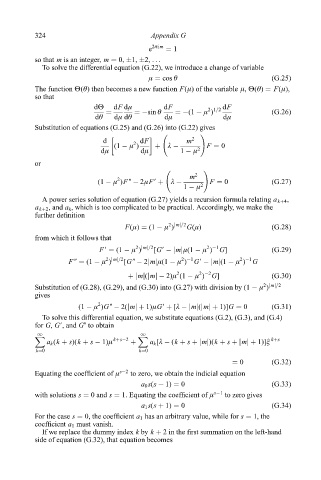
                               To solve the differential equation (G.22), we introduce a change of variable
                                                             ì ˆ cos è                         (G:25)
                             The function È(è) then becomes a new function F(ì) of the variable ì, È(è) ˆ F(ì),
                             so that
                                              dÈ   dF dì         dF          2 1=2  dF
                                                 ˆ       ˆÿsin è    ˆÿ(1 ÿ ì )                 (G:26)
                                              dè   dì dè         dì               dì
                             Substitution of equations (G.25) and (G.26) into (G.22) gives
                                                                           !
                                                                         2
                                                d        2  dF         m
                                                   (1 ÿ ì )    ‡  ë ÿ        F ˆ 0
                                               dì          dì         1 ÿ ì 2
                             or
                                                                            !
                                                                        m 2
                                                    2
                                               (1 ÿ ì )F 0 ÿ 2ìF9 ‡  ë ÿ      F ˆ 0            (G:27)
                                                                       1 ÿ ì 2
                               A power series solution of equation (G.27) yields a recursion formula relating a k‡4 ,
                             a k‡2 , and a k , which is too complicated to be practical. Accordingly, we make the
                             further de®nition
                                                                  2 jmj=2
                                                      F(ì) ˆ (1 ÿ ì )  G(ì)                    (G:28)
                             from which it follows that
                                                                             2 ÿ1
                                                         2 jmj=2
                                               F9 ˆ (1 ÿ ì )  [G9 ÿjmjì(1 ÿ ì ) G]             (G:29)
                                                                                      2 ÿ1
                                                                      2 ÿ1
                                                 2 jmj=2
                                      F 0 ˆ (1 ÿ ì )  [G0 ÿ 2jmjì(1 ÿ ì ) G9 ÿjmj(1 ÿ ì ) G
                                                                           2 ÿ2
                                                                     2
                                                       ‡jmj(jmjÿ 2)ì (1 ÿ ì ) G]               (G:30)
                                                                                             2 jmj=2
                             Substitution of (G.28), (G.29), and (G.30) into (G.27) with division by (1 ÿ ì )
                             gives
                                               2
                                         (1 ÿ ì )G0 ÿ 2(jmj‡ 1)ìG9 ‡ [ë ÿjmj(jmj‡ 1)]G ˆ 0     (G:31)
                               To solve this differential equation, we substitute equations (G.2), (G.3), and (G.4)
                             for G, G9, and G0 to obtain
                              1                            1
                             X                     k‡sÿ2  X                                    k‡s
                                a k (k ‡ s)(k ‡ s ÿ 1)ì  ‡   a k [ë ÿ (k ‡ s ‡jmj)(k ‡ s ‡jmj‡ 1)]î
                             kˆ0                          kˆ0
                                                                                    ˆ 0        (G:32)
                             Equating the coef®cient of ì sÿ2  to zero, we obtain the indicial equation
                                                           a 0 s(s ÿ 1) ˆ 0                    (G:33)
                             with solutions s ˆ 0 and s ˆ 1. Equating the coef®cient of ì sÿ1  to zero gives
                                                           a 1 s(s ‡ 1) ˆ 0                    (G:34)
                             For the case s ˆ 0, the coef®cient a 1 has an arbitrary value, while for s ˆ 1, the
                             coef®cient a 1 must vanish.
                               If we replace the dummy index k by k ‡ 2 in the ®rst summation on the left-hand
                             side of equation (G.32), that equation becomes
   328   329   330   331   332   333   334   335   336   337   338