


Page 334 - PRINCIPLES OF QUANTUM MECHANICS as Applied to Chemistry and Chemical Physics
P. 334
Series solutions of differential equations 325
1
X ks
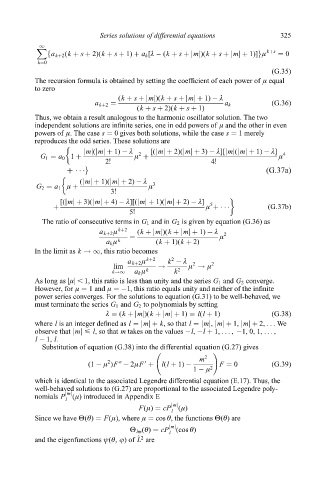
fa k2 (k s 2)(k s 1) a k [ë ÿ (k s jmj)(k s jmj 1)]gì 0
k0
(G:35)
The recursion formula is obtained by setting the coef®cient of each power of ì equal
to zero
(k s jmj)(k s jmj 1) ÿ ë
a k2 a k (G:36)
(k s 2)(k s 1)
Thus, we obtain a result analogous to the harmonic oscillator solution. The two
independent solutions are in®nite series, one in odd powers of ì and the other in even
powers of ì. The case s 0 gives both solutions, while the case s 1 merely
reproduces the odd series. These solutions are
jmj(jmj 1) ÿ ë 2 [(jmj 2)(jmj 3) ÿ ë][jmj(jmj 1) ÿ ë] 4
G 1 a 0 1 ì ì
2! 4!
g (G:37a)
(jmj 1)(jmj 2) ÿ ë 3
G 2 a 1 ì ì
3!
[(jmj 3)(jmj 4) ÿ ë][(jmj 1)(jmj 2) ÿ ë] 5
ì (G:37b)
5!
The ratio of consecutive terms in G 1 and in G 2 is given by equation (G.36) as
a k2 ì k2 (k jmj)(k jmj 1) ÿ ë
ì 2
a k ì k (k 1)(k 2)
In the limit as k !1, this ratio becomes
2
a k2 ì k2 k ÿ ë
2
lim k ! 2 ì ! ì 2
k!1 a k ì k
As long as jìj , 1, this ratio is less than unity and the series G 1 and G 2 converge.
However, for ì 1 and ì ÿ1, this ratio equals unity and neither of the in®nite
power series converges. For the solutions to equation (G.31) to be well-behaved, we
must terminate the series G 1 and G 2 to polynomials by setting
ë (k jmj)(k jmj 1) l(l 1) (G:38)
where l is an integer de®ned as l jmj k, so that l jmj, jmj 1, jmj 2, .. . We
observe that jmj < l, so that m takes on the values ÿl, ÿl 1, .. . , ÿ1, 0, 1, ... ,
l ÿ 1, l.
Substitution of equation (G.38) into the differential equation (G.27) gives
!
m 2
2
(1 ÿ ì )F 0 ÿ 2ìF9 l(l 1) ÿ F 0 (G:39)
1 ÿ ì 2
which is identical to the associated Legendre differential equation (E.17). Thus, the
well-behaved solutions to (G.27) are proportional to the associated Legendre poly-
nomials P jmj (ì) introduced in Appendix E
l
F(ì) cP jmj (ì)
l
Since we have È(è) F(ì), where ì cos è, the functions È(è) are
È lm (è) cP jmj (cos è)
l
^ 2
and the eigenfunctions ø(è, j)of L are

