


Page 339 - PRINCIPLES OF QUANTUM MECHANICS as Applied to Chemistry and Chemical Physics
P. 339
330 Appendix H
1 1 1
í
í
r uu9 dr ÿí r íÿ1 2 r uu9 dr
u dr ÿ
0 0 0
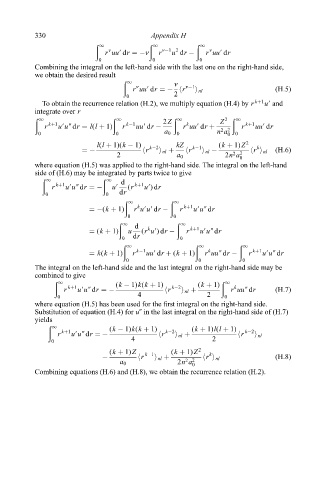
Combining the integral on the left-hand side with the last one on the right-hand side,
we obtain the desired result
1 í
í
r uu9 dr ÿ hr íÿ1 i nl (H:5)
0 2
To obtain the recurrence relation (H.2), we multiply equation (H.4) by r k1 u9 and
integrate over r
2
1 1 2Z 1 Z 1
k
r k1 u9u0 dr l(l 1) r kÿ1 uu9 dr ÿ r uu9 dr 2 2 r k1 uu9 dr
0 0 a 0 0 n a 0 0
l(l 1)(k ÿ 1) kÿ2 kZ kÿ1 (k 1)Z 2 k
ÿ hr i nl hr i nl ÿ hr i nl (H:6)
2 2
2 a 0 2n a
0
where equation (H.5) was applied to the right-hand side. The integral on the left-hand
side of (H.6) may be integrated by parts twice to give
1 1 d
r k1 u9u0 dr ÿ u9 (r k1 u9)dr
0 0 dr
1 1
k
ÿ(k 1) r u9u9 dr ÿ r k1 u9u0 dr
0 0
1 d 1
k
(k 1) u (r u9)dr ÿ r k1 u9u0 dr
0 dr 0
1 1 1
k
k(k 1) r kÿ1 uu9 dr (k 1) r uu0 dr ÿ r k1 u9u0 dr
0 0 0
The integral on the left-hand side and the last integral on the right-hand side may be
combined to give
1 (k ÿ 1)k(k 1) (k 1) 1
k1 kÿ2 k
r u9u0 dr ÿ hr i nl r uu0 dr (H:7)
0 4 2 0
where equation (H.5) has been used for the ®rst integral on the right-hand side.
Substitution of equation (H.4) for u0 in the last integral on the right-hand side of (H.7)
yields
1 (k ÿ 1)k(k 1) (k 1)l(l 1)
r k1 u9u0 dr ÿ hr kÿ2 i nl hr kÿ2 i nl
0 4 2
(k 1)Z kÿ1 (k 1)Z 2 k
ÿ hr i nl 2 2 hr i nl (H:8)
a 0 2n a 0
Combining equations (H.6) and (H.8), we obtain the recurrence relation (H.2).

