


Page 340 - PRINCIPLES OF QUANTUM MECHANICS as Applied to Chemistry and Chemical Physics
P. 340
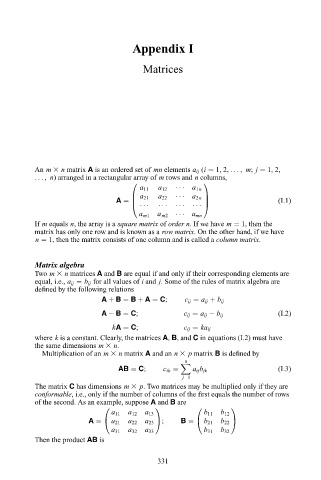
Appendix I
Matrices
An m 3 n matrix A is an ordered set of mn elements a ij (i 1, 2, .. . , m; j 1, 2,
.. . , n) arranged in a rectangular array of m rows and n columns,
0 1
a 11 a 12 a 1n
B C
a 21 a 22 a 2n
A B C (I:1)
@ A
a m1 a m2 a mn
If m equals n, the array is a square matrix of order n.Ifwehave m 1, then the
matrix has only one row and is known as a row matrix. On the other hand, if we have
n 1, then the matrix consists of one column and is called a column matrix.
Matrix algebra
Two m 3 n matrices A and B are equal if and only if their corresponding elements are
equal, i.e., a ij b ij for all values of i and j. Some of the rules of matrix algebra are
de®ned by the following relations
A B B A C; c ij a ij b ij
A ÿ B C; c ij a ij ÿ b ij (I:2)
kA C; c ij ka ij
where k is a constant. Clearly, the matrices A, B, and C in equations (I.2) must have
the same dimensions m 3 n.
Multiplication of an m 3 n matrix A and an n 3 p matrix B is de®ned by
n
X
AB C; c ik a ij b jk (I:3)
j1
The matrix C has dimensions m 3 p. Two matrices may be multiplied only if they are
conformable, i.e., only if the number of columns of the ®rst equals the number of rows
of the second. As an example, suppose A and B are
0 1 0 1
a 11 a 12 a 13 b 11 b 12
A @ a 21 a 22 a 23 A ; B @ b 21 b 22 A
a 31 a 32 a 33 b 31 b 32
Then the product AB is
331

