


Page 349 - PRINCIPLES OF QUANTUM MECHANICS as Applied to Chemistry and Chemical Physics
P. 349
340 Appendix I
Trace
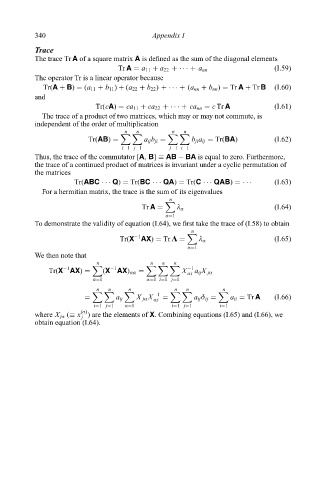
The trace Tr A of a square matrix A is de®ned as the sum of the diagonal elements
(I:59)
Tr A a 11 a 22 a nn
The operator Tr is a linear operator because
Tr(A B) (a 11 b 11 ) (a 22 b 22 ) (a nn b nn ) Tr A Tr B (I:60)
and
Tr(cA) ca 11 ca 22 ca nn c Tr A (I:61)
The trace of a product of two matrices, which may or may not commute, is
independent of the order of multiplication
n n n n
X X X X
Tr(AB) a ij b ji b ji a ij Tr(BA) (I:62)
i1 j1 j1 i1
Thus, the trace of the commutator [A, B] AB ÿ BA is equal to zero. Furthermore,
the trace of a continued product of matrices is invariant under a cyclic permutation of
the matrices
Tr(ABC Q) Tr(BC QA) Tr(C QAB) (I:63)
For a hermitian matrix, the trace is the sum of its eigenvalues
n
X
Tr A ë á (I:64)
á1
To demonstrate the validity of equation (I.64), we ®rst take the trace of (I.58) to obtain
n
X
ÿ1
Tr(X AX) Tr Ë ë á (I:65)
á1
We then note that
n n n n
X X X X
ÿ1 ÿ1 ÿ1
Tr(X AX) (X AX) áá X a ij X já
ái
á1 á1 i1 j1
n n n n n n
X X X ÿ1 X X X
a ij X já X a ij ä ij a ii Tr A (I:66)
ái
i1 j1 á1 i1 j1 i1
(á)
where X já ( x ) are the elements of X. Combining equations (I.65) and (I.66), we
j
obtain equation (I.64).

