


Page 120 - Partition & Adsorption of Organic Contaminants in Environmental Systems
P. 120
BACKGROUND IN SORPTION STUDIES     111


                         (a)           Total soil uptake (nonlinear)
                     Sorbed Mass, Q (arbitrary scale)  Adsorption on minerals (nonlinear)


                                             0.5
                       0         Partition to organic matter (linear)  1.0
                                Relative Vapor Concentration, P/P°

                        (b)  Total soil uptake (relatively linear)
                     Sorbed Mass, Q (arbitrary scale)  Partition to organic matter (linear)


                               Adsorption on minerals (linear or nonlinear)

                       0                     0.5                    1.0
                               Relative Aqueous Concentration, C /S w
                                                           e
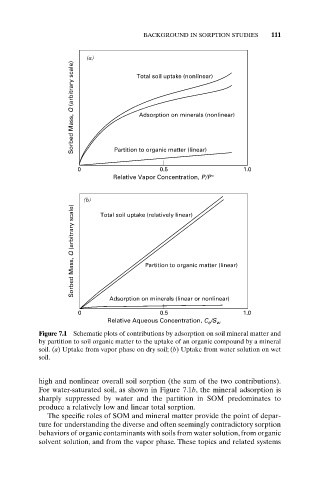
            Figure 7.1  Schematic plots of contributions by adsorption on soil mineral matter and
            by partition to soil organic matter to the uptake of an organic compound by a mineral
            soil. (a) Uptake from vapor phase on dry soil; (b) Uptake from water solution on wet
            soil.


            high and nonlinear overall soil sorption (the sum of the two contributions).
            For water-saturated soil, as shown in Figure 7.1b, the mineral adsorption is
            sharply suppressed by water and the partition in SOM predominates to
            produce a relatively low and linear total sorption.
              The specific roles of SOM and mineral matter provide the point of depar-
            ture for understanding the diverse and often seemingly contradictory sorption
            behaviors of organic contaminants with soils from water solution, from organic
            solvent solution, and from the vapor phase. These topics and related systems

