


Page 123 - Partition & Adsorption of Organic Contaminants in Environmental Systems
P. 123
114   CONTAMINANT SORPTION TO SOILS AND NATURAL SOLIDS

                    1200                                  1,2-Dibromoethane
                                             1,1,2,2-Tetrachloroethane
                                  1,1,1-Trichloroethane
                    Uptake by Soil, Q   (µg/g)  800  Tetrachloroethene 1,2-Dichlorobenzene  (    20°C)                   (     3.5°C) 1,1,1-Trichloroethane (3.5°C)  1,2-Dichloropropane


                     400
                                          1,2-Dichloroethane


                       0
                        0            600          1200          1800
                                 Equilibrium Concentration, C (mg/L)
                                                        e
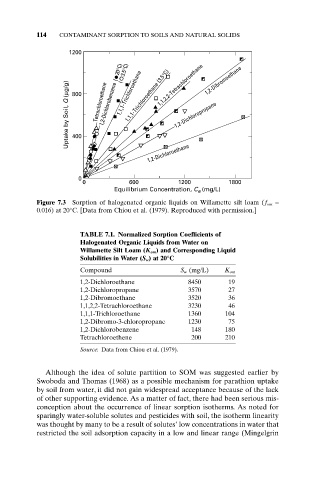
           Figure 7.3  Sorption of halogenated organic liquids on Willamette silt loam (f om =
           0.016) at 20°C. [Data from Chiou et al. (1979). Reproduced with permission.]


                       TABLE 7.1. Normalized Sorption Coefficients of
                       Halogenated Organic Liquids from Water on
                       Willamette Silt Loam (K om) and Corresponding Liquid
                       Solubilities in Water (S w) at 20°C
                       Compound                    S w (mg/L)  K om
                       1,2-Dichloroethane            8450       19
                       1,2-Dichloropropane           3570       27
                       1,2-Dibromoethane             3520       36
                       1,1,2,2-Tetrachloroethane     3230       46
                       1,1,1-Trichloroethane         1360       104
                       1,2-Dibromo-3-chloropropane   1230       75
                       1,2-Dichlorobenzene            148       180
                       Tetrachloroethene              200       210
                       Source: Data from Chiou et al. (1979).


              Although the idea of solute partition to SOM was suggested earlier by
           Swoboda and Thomas (1968) as a possible mechanism for parathion uptake
           by soil from water, it did not gain widespread acceptance because of the lack
           of other supporting evidence. As a matter of fact, there had been serious mis-
           conception about the occurrence of linear sorption isotherms. As noted for
           sparingly water-soluble solutes and pesticides with soil, the isotherm linearity
           was thought by many to be a result of solutes’ low concentrations in water that
           restricted the soil adsorption capacity in a low and linear range (Mingelgrin

