


Page 122 - Partition & Adsorption of Organic Contaminants in Environmental Systems
P. 122
SORPTION FROM WATER SOLUTION     113

                       0         400         800        1200        1600
                    240      Benzene (upper and right scales)
                             1,3-Dichlorobenzene
                   Uptake by Soil, Q (µg/g)   160                     600
                             1,2,4-Trichlorobenzene


                     80
                                                                      400

                                                                      200

                      0                                               0
                       0          20          40         60          80
                                Equilibrium Concentration, C  (mg/L)
                                                       e
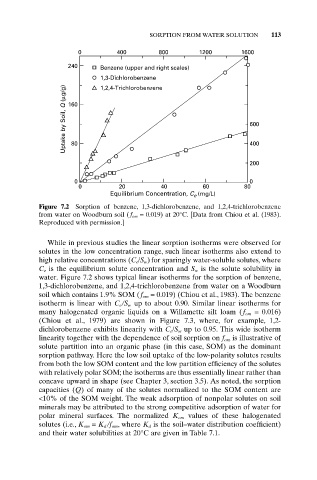
            Figure 7.2  Sorption of benzene, 1,3-dichlorobenzene, and 1,2,4-trichlorobenzene
            from water on Woodburn soil ( f om = 0.019) at 20°C. [Data from Chiou et al. (1983).
            Reproduced with permission.]


              While in previous studies the linear sorption isotherms were observed for
            solutes in the low concentration range, such linear isotherms also extend to
            high relative concentrations (C e /S w ) for sparingly water-soluble solutes, where
            C e is the equilibrium solute concentration and S w is the solute solubility in
            water. Figure 7.2 shows typical linear isotherms for the sorption of benzene,
            1,3-dichlorobenzene, and 1,2,4-trichlorobenzene from water on a Woodburn
            soil which contains 1.9% SOM (f om = 0.019) (Chiou et al., 1983). The benzene
            isotherm is linear with C e /S w up to about 0.90. Similar linear isotherms for
            many halogenated organic liquids on a  Willamette silt loam (f om = 0.016)
            (Chiou et al., 1979) are shown in Figure 7.3, where, for example, 1,2-
            dichlorobenzene exhibits linearity with C e/S w up to 0.95. This wide isotherm
            linearity together with the dependence of soil sorption on f om is illustrative of
            solute partition into an organic phase (in this case, SOM) as the dominant
            sorption pathway. Here the low soil uptake of the low-polarity solutes results
            from both the low SOM content and the low partition efficiency of the solutes
            with relatively polar SOM; the isotherms are thus essentially linear rather than
            concave upward in shape (see Chapter 3, section 3.5). As noted, the sorption
            capacities (Q) of many of the solutes normalized to the SOM content are
            <10% of the SOM weight. The weak adsorption of nonpolar solutes on soil
            minerals may be attributed to the strong competitive adsorption of water for
            polar mineral surfaces. The normalized  K om values of these halogenated
            solutes (i.e., K om = K d /f om, where K d is the soil–water distribution coefficient)
            and their water solubilities at 20°C are given in Table 7.1.

