


Page 129 - Partition & Adsorption of Organic Contaminants in Environmental Systems
P. 129
120   CONTAMINANT SORPTION TO SOILS AND NATURAL SOLIDS

           where S om is the solute solubility in SOM and S w the solute solubility in water.
                                                                           5
           For solid DDT with S w = 5.5mg/L (Weil et al., 1974) and K om   1.5 ¥ 10 at
           25°C, one therefore gets  S om   830mg/kg, or 0.83g/kg. By comparison, the
           solubility of DDT in pure octanol is about 42g/L (Chiou et al., 1982b), which
           is some 50 times its solubility in SOM. The low estimated solubility of DDT
           in SOM is much expected for a relatively nonpolar solid compound in a polar
           macromolecular amorphous material. It is evident from these data that the
           very high sorption coefficient of DDT results primarily from its extremely low
           water solubility, which gives rise to a high partition coefficient.
              On the premise of solute partition, one expects organic compounds with
           high water solubility to also exhibit high S om values because these compounds
           are usually also more compatible with organic solvents. For example, as shown
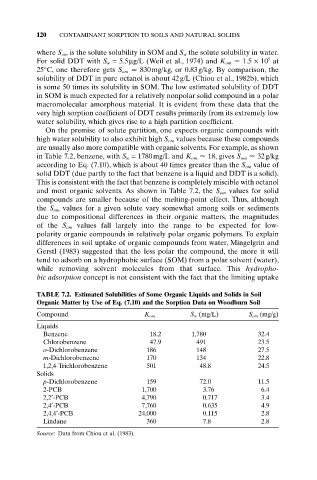
           in Table 7.2, benzene, with S w = 1780mg/L and K om   18, gives S om   32g/kg
           according to Eq. (7.10), which is about 40 times greater than the S om value of
           solid DDT (due partly to the fact that benzene is a liquid and DDT is a solid).
           This is consistent with the fact that benzene is completely miscible with octanol
           and most organic solvents. As shown in Table 7.2, the  S om values for solid
           compounds are smaller because of the melting-point effect. Thus, although
           the  S om values for a given solute vary somewhat among soils or sediments
           due to compositional differences in their organic matters, the magnitudes
           of the  S om values fall largely into the range to be expected for low-
           polarity organic compounds in relatively polar organic polymers. To explain
           differences in soil uptake of organic compounds from water, Mingelgrin and
           Gerstl (1983) suggested that the less polar the compound, the more it will
           tend to adsorb on a hydrophobic surface (SOM) from a polar solvent (water),
           while removing solvent molecules from that surface. This  hydropho-
           bic adsorption concept is not consistent with the fact that the limiting uptake

           TABLE 7.2. Estimated Solubilities of Some Organic Liquids and Solids in Soil
           Organic Matter by Use of Eq. (7.10) and the Sorption Data on Woodburn Soil
           Compound                      K om         S w (mg/L)      S om (mg/g)
           Liquids
             Benzene                       18.2       1,780              32.4
             Chlorobenzene                 47.9         491              23.5
             o-Dichlorobenzene            186           148              27.5
             m-Dichlorobenzene            170           134              22.8
             1,2,4-Trichlorobenzene       501           48.8             24.5
           Solids
             p-Dichlorobenzene            159           72.0             11.5
             2-PCB                      1,700            3.76             6.4
             2,2¢-PCB                   4,790            0.717            3.4
             2,4¢-PCB                   7,760            0.635            4.9
             2,4,4¢-PCB                24,000            0.115            2.8
             Lindane                      360            7.8              2.8
           Source: Data from Chiou et al. (1983).

