


Page 307 - Physical chemistry understanding our chemical world
P. 307
274    ACIDS AND BASES


                       Why do some hydrangea bushes look red and others
                       blue?

                      The chemical basis of acid–base indicators

                                      Hydrangeas (genus Hydrangea) are beautiful bushy plants having
              The name ‘hydrangea’    multiple flower heads. In soils comprising much compost the flow-
              derives from classi-
                                      ers have a blue colour, but in soils with much lime or bone meal
              cal Greek mythol-       the heads are pink or even crimson–pink in colour. Very occa-
              ogy, in which the
                                      sionally, the flowers are mauve. ‘Lime’ is the old-fashioned name
              ‘hydra’ was a beast
              with many heads.        for calcium oxide, and is alkaline; bone meal contains a lot of
                                      phosphate, which is also likely to raise the soil pH. The colour of
                                      the hydrangea is therefore an indication of the acid content of the
                                      soil: the flower of a hydrangea is blue in acidic soil because the
              The word ‘chromo-
              phore’ comes from two   plant sap is slightly acidic; red hydrangeas exist in alkaline soil
              Greek words, ‘khro-     because the sap transports alkali from the soil to the petals. The
              mos’ meaning colour     rare mauve hydrangea indicates a soil of neutral pH. We see how
              and ‘phoro’, which      the chromophore in the flower is an acid–base indicator.
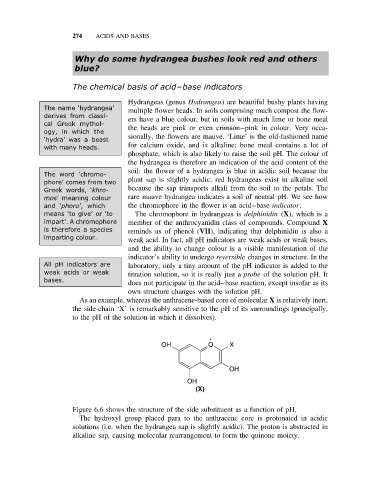
              means ‘to give’ or ‘to    The chromophore in hydrangeas is delphinidin (X), which is a
              impart’. A chromophore  member of the anthrocyanidin class of compounds. Compound X
              is therefore a species  reminds us of phenol (VII), indicating that delphinidin is also a
              imparting colour.       weak acid. In fact, all pH indicators are weak acids or weak bases,
                                      and the ability to change colour is a visible manifestation of the
                                      indicator’s ability to undergo reversible changes in structure. In the
              All pH indicators are   laboratory, only a tiny amount of the pH indicator is added to the
              weak acids or weak      titration solution, so it is really just a probe of the solution pH. It
              bases.                  does not participate in the acid–base reaction, except insofar as its
                                      own structure changes with the solution pH.
                        As an example, whereas the anthracene-based core of molecular X is relatively inert,
                      the side-chain ‘X’ is remarkably sensitive to the pH of its surroundings (principally,
                      to the pH of the solution in which it dissolves).


                                                              +
                                                OH           O      X


                                                                    OH

                                                       OH
                                                          (X)


                      Figure 6.6 shows the structure of the side substituent as a function of pH.
                        The hydroxyl group placed para to the anthracene core is protonated in acidic
                      solutions (i.e. when the hydrangea sap is slightly acidic). The proton is abstracted in
                      alkaline sap, causing molecular rearrangement to form the quinone moiety.

