


Page 309 - Physical chemistry understanding our chemical world
P. 309
276    ACIDS AND BASES


                       Why does phenolphthalein indicator not turn red until
                       pH 8.2?

                      Which acid–base indicator to use?

                      Litmus was probably the most popular choice of acid–base indicator, but it is not a
                      good choice for colour-blind chemists. The use of phenolphthalein as an acid–base
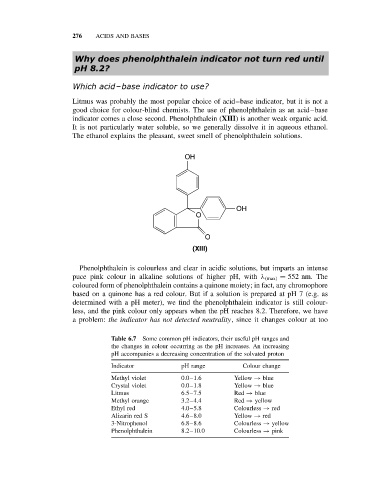
                      indicator comes a close second. Phenolphthalein (XIII) is another weak organic acid.
                      It is not particularly water soluble, so we generally dissolve it in aqueous ethanol.
                      The ethanol explains the pleasant, sweet smell of phenolphthalein solutions.


                                                       OH


                                                                      OH
                                                          O


                                                             O

                                                         (XIII)

                        Phenolphthalein is colourless and clear in acidic solutions, but imparts an intense
                      puce pink colour in alkaline solutions of higher pH, with λ (max) = 552 nm. The
                      coloured form of phenolphthalein contains a quinone moiety; in fact, any chromophore
                      based on a quinone has a red colour. But if a solution is prepared at pH 7 (e.g. as
                      determined with a pH meter), we find the phenolphthalein indicator is still colour-
                      less, and the pink colour only appears when the pH reaches 8.2. Therefore, we have
                      a problem: the indicator has not detected neutrality, since it changes colour at too


                                 Table 6.7 Some common pH indicators, their useful pH ranges and
                                 the changes in colour occurring as the pH increases. An increasing
                                 pH accompanies a decreasing concentration of the solvated proton
                                 Indicator            pH range          Colour change
                                 Methyl violet        0.0–1.6        Yellow → blue
                                 Crystal violet       0.0–1.8        Yellow → blue
                                 Litmus               6.5–7.5        Red → blue
                                 Methyl orange        3.2–4.4        Red → yellow
                                 Ethyl red            4.0–5.8        Colourless → red
                                 Alizarin red S       4.6–8.0        Yellow → red
                                 3-Nitrophenol        6.8–8.6        Colourless → yellow
                                 Phenolphthalein      8.2–10.0       Colourless → pink

