


Page 305 - Physical chemistry understanding our chemical world
P. 305
272    ACIDS AND BASES

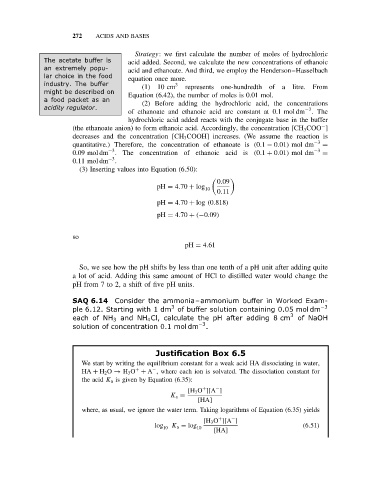
                                        Strategy: we first calculate the number of moles of hydrochloric
              The acetate buffer is   acid added. Second, we calculate the new concentrations of ethanoic
              an extremely popu-      acid and ethanoate. And third, we employ the Henderson–Hasselbach
              lar choice in the food
                                      equation once more.
              industry. The buffer        (1)  10 cm 3  represents  one-hundredth  of  a  litre.  From
              might be described on
                                      Equation (6.42), the number of moles is 0.01 mol.
              a food packet as an         (2) Before adding the hydrochloric acid, the concentrations
              acidity regulator.                                                          −3
                                      of ethanoate and ethanoic acid are constant at 0.1 mol dm .The
                                      hydrochloric acid added reacts with the conjugate base in the buffer
                                                                                              −
                      (the ethanoate anion) to form ethanoic acid. Accordingly, the concentration [CH 3 COO ]
                      decreases and the concentration [CH 3 COOH] increases. (We assume the reaction is
                      quantitative.) Therefore, the concentration of ethanoate is (0.1 − 0.01) mol dm −3  =
                                −3
                      0.09 mol dm . The concentration of ethanoic acid is (0.1 + 0.01) mol dm −3  =
                                −3
                      0.11 mol dm .
                        (3) Inserting values into Equation (6.50):

                                                                0.09
                                               pH = 4.70 + log 10
                                                                0.11
                                               pH = 4.70 + log (0.818)
                                               pH = 4.70 + (−0.09)


                      so
                                                       pH = 4.61


                        So, we see how the pH shifts by less than one tenth of a pH unit after adding quite
                      a lot of acid. Adding this same amount of HCl to distilled water would change the
                      pH from 7 to 2, a shift of five pH units.

                      SAQ 6.14 Consider the ammonia–ammonium buffer in Worked Exam-
                                                   3
                      ple 6.12. Starting with 1 dm of buffer solution containing 0.05 mol dm  −3
                      each of NH 3 and NH 4 Cl, calculate the pH after adding 8 cm   3  of NaOH
                      solution of concentration 0.1 mol dm −3 .


                                              Justification Box 6.5
                         We start by writing the equilibrium constant for a weak acid HA dissociating in water,
                                        +
                         HA + H 2 O → H 3 O + A , where each ion is solvated. The dissociation constant for
                                             −
                         the acid K a is given by Equation (6.35):
                                                            +
                                                                −
                                                        [H 3 O ][A ]
                                                  K a =
                                                          [HA]
                         where, as usual, we ignore the water term. Taking logarithms of Equation (6.35) yields
                                                                +
                                                                    −
                                                            [H 3 O ][A ]
                                              log  K a = log                             (6.51)
                                                10        10
                                                               [HA]

