


Page 300 - Physical chemistry understanding our chemical world
P. 300
pH BUFFERS    267


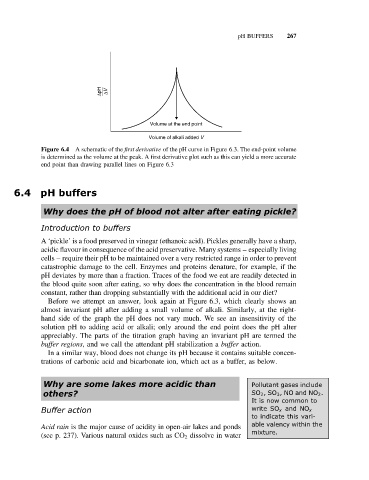
                              ∆pH  ∆V


                                             Volume at the end point

                                            Volume of alkali added V
             Figure 6.4 A schematic of the first derivative of the pH curve in Figure 6.3. The end-point volume
             is determined as the volume at the peak. A first derivative plot such as this can yield a more accurate
             end point than drawing parallel lines on Figure 6.3


     6.4     pH buffers


              Why does the pH of blood not alter after eating pickle?
             Introduction to buffers

             A ‘pickle’ is a food preserved in vinegar (ethanoic acid). Pickles generally have a sharp,
             acidic flavour in consequence of the acid preservative. Many systems – especially living
             cells – require their pH to be maintained over a very restricted range in order to prevent
             catastrophic damage to the cell. Enzymes and proteins denature, for example, if the
             pH deviates by more than a fraction. Traces of the food we eat are readily detected in
             the blood quite soon after eating, so why does the concentration in the blood remain
             constant, rather than dropping substantially with the additional acid in our diet?
               Before we attempt an answer, look again at Figure 6.3, which clearly shows an
             almost invariant pH after adding a small volume of alkali. Similarly, at the right-
             hand side of the graph the pH does not vary much. We see an insensitivity of the
             solution pH to adding acid or alkali; only around the end point does the pH alter
             appreciably. The parts of the titration graph having an invariant pH are termed the
             buffer regions, and we call the attendant pH stabilization a buffer action.
               In a similar way, blood does not change its pH because it contains suitable concen-
             trations of carbonic acid and bicarbonate ion, which act as a buffer, as below.


              Why are some lakes more acidic than                         Pollutant gases include
              others?                                                     SO 2 ,SO 3 ,NO and NO 2 .
                                                                          It is now common to
             Buffer action                                                write SO x and NO x
                                                                          to indicate this vari-
             Acid rain is the major cause of acidity in open-air lakes and ponds  able valency within the
                                                                          mixture.
             (see p. 237). Various natural oxides such as CO 2 dissolve in water

