


Page 296 - Physical chemistry understanding our chemical world
P. 296
TITRATION ANALYSES    263

             A similar process occurs when we spread a thick paste of zinc and
                                                                          Some campaigners
             castor oil on a baby’s bottom each time we change its nappy. The
                                                                          believe the AlCl 3 pro-
             ‘zinc’ is in fact zinc oxide, ZnO, which, being amphoteric, reacts
                                                                          duced by Equation
             with the uric acid in the baby’s urine, thereby neutralizing it.
                                                                          (6.40) hastens the
                                                                          onset of Alzheimer’s
             Worked Example 6.9 But how much stomach acid is neutralized  disease. Certainly, the
             by a single indigestion tablet? The tablet contains 0.01 mol of MOH,  brains of people with
                                               +
             where ‘M’ is a monovalent metal and M its cation.            this nasty condition
                                                                          contain too much alu-
             We first consider the reaction in the stomach, saying it proceeds with  minium.
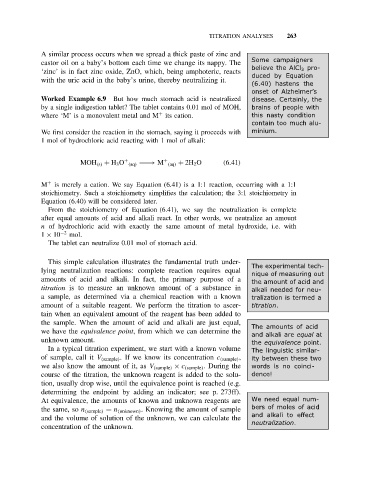
             1 mol of hydrochloric acid reacting with 1 mol of alkali:


                                     +
                                                 +
                        MOH (s) + H 3 O (aq) −−−→ M (aq) + 2H 2 O  (6.41)
             M is merely a cation. We say Equation (6.41) is a 1:1 reaction, occurring with a 1:1
               +
             stoichiometry. Such a stoichiometry simplifies the calculation; the 3:1 stoichiometry in
             Equation (6.40) will be considered later.
               From the stoichiometry of Equation (6.41), we say the neutralization is complete
             after equal amounts of acid and alkali react. In other words, we neutralize an amount
             n of hydrochloric acid with exactly the same amount of metal hydroxide, i.e. with
             1 × 10 −2  mol.
               The tablet can neutralize 0.01 mol of stomach acid.

               This simple calculation illustrates the fundamental truth under-
                                                                          The experimental tech-
             lying neutralization reactions: complete reaction requires equal
                                                                          nique of measuring out
             amounts of acid and alkali. In fact, the primary purpose of a
                                                                          the amount of acid and
             titration is to measure an unknown amount of a substance in  alkali needed for neu-
             a sample, as determined via a chemical reaction with a known  tralization is termed a
             amount of a suitable reagent. We perform the titration to ascer-  titration.
             tain when an equivalent amount of the reagent has been added to
             the sample. When the amount of acid and alkali are just equal,
                                                                          The amounts of acid
             we have the equivalence point, from which we can determine the  and alkali are equal at
             unknown amount.
                                                                          the equivalence point.
               In a typical titration experiment, we start with a known volume  The linguistic similar-
             of sample, call it V (sample) . If we know its concentration c (sample) ,  ity between these two
             we also know the amount of it, as V (sample) × c (sample) . During the  words is no coinci-
             course of the titration, the unknown reagent is added to the solu-  dence!
             tion, usually drop wise, until the equivalence point is reached (e.g.
             determining the endpoint by adding an indicator; see p. 273ff).
             At equivalence, the amounts of known and unknown reagents are  We need equal num-
             the same, so n (sample) = n (unknown) . Knowing the amount of sample  bers of moles of acid
                                                                          and alkali to effect
             and the volume of solution of the unknown, we can calculate the
                                                                          neutralization.
             concentration of the unknown.

