


Page 298 - Physical chemistry understanding our chemical world
P. 298
TITRATION ANALYSES    265

                                                                   3
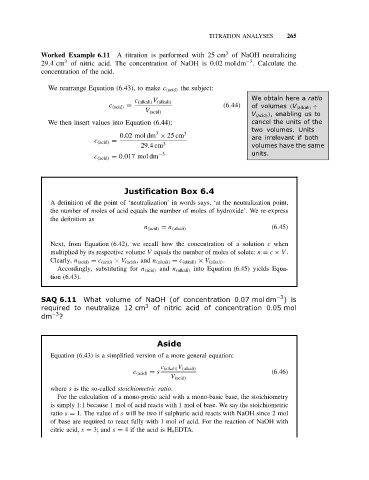
             Worked Example 6.11 A titration is performed with 25 cm of NaOH neutralizing
                    3
                                                                        −3
             29.4cm of nitric acid. The concentration of NaOH is 0.02 mol dm . Calculate the
             concentration of the acid.
               We rearrange Equation (6.43), to make c (acid) the subject:
                                                                          We obtain here a ratio
                                        c (alkali) V (alkali)
                                 c (acid) =                       (6.44)  of volumes (V (alkali) ÷
                                           V (acid)
                                                                          V (acid) ), enabling us to
               We then insert values into Equation (6.44):                cancel the units of the
                                                                          two volumes. Units
                                              3
                                    0.02 mol dm × 25 cm 3                 are irrelevant if both
                            c (acid) =
                                          29.4cm 3                        volumes have the same
                            c (acid) = 0.017 mol dm −3                    units.


                                     Justification Box 6.4
                A definition of the point of ‘neutralization’ in words says, ‘at the neutralization point,
                the number of moles of acid equals the number of moles of hydroxide’. We re-express
                the definition as
                                           n (acid) = n (alkali)                (6.45)

                Next, from Equation (6.42), we recall how the concentration of a solution c when
                multiplied by its respective volume V equals the number of moles of solute: n = c × V .
                Clearly, n (acid) = c (acid) × V (acid) ,and n (alkali) = c (alkali) × V (alkali) .
                  Accordingly, substituting for n (acid) and n (alkali) into Equation (6.45) yields Equa-
                tion (6.43).


             SAQ 6.11 What volume of NaOH (of concentration 0.07 mol dm          −3 )is
             required to neutralize 12 cm  3  of nitric acid of concentration 0.05 mol
             dm −3 ?


                                               Aside

                Equation (6.43) is a simplified version of a more general equation:
                                                c (alkali) V (alkali)
                                        c (acid) = s                            (6.46)
                                                   V (acid)
                where s is the so-called stoichiometric ratio.
                  For the calculation of a mono-protic acid with a mono-basic base, the stoichiometry
                is simply 1:1 because 1 mol of acid reacts with 1 mol of base. We say the stoichiometric
                ratio s = 1. The value of s will be two if sulphuric acid reacts with NaOH since 2 mol
                of base are required to react fully with 1 mol of acid. For the reaction of NaOH with
                citric acid, s = 3; and s = 4if theacidisH 4 EDTA.

