


Page 299 - Physical chemistry understanding our chemical world
P. 299
266    ACIDS AND BASES


                                                                        1
                           The value of s when Ca(OH) reacts with HNO 3 will be , and the value when citric
                                                  2
                                                                        2
                                                    3
                         acid reacts with Ca(OH) will be .
                                            2
                                                    2
                      SAQ 6.12 What volume of Ca(OH)        2  (of concentration 0.20 mol dm −3 )
                                                      3
                      is required to neutralize 50 cm of nitric acid of concentration 0.10 mol
                      dm −3 ?
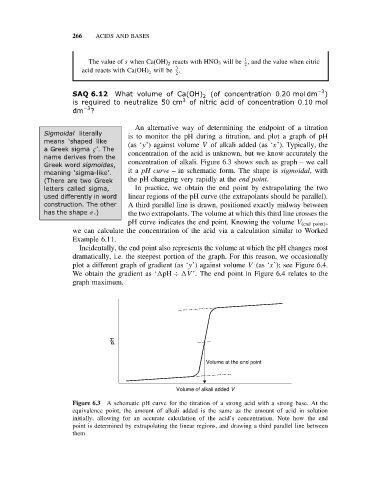
                                        An alternative way of determining the endpoint of a titration
              Sigmoidal literally     is to monitor the pH during a titration, and plot a graph of pH
              means ‘shaped like      (as ‘y’) against volume V of alkali added (as ‘x’). Typically, the
              a Greek sigma ς’. The   concentration of the acid is unknown, but we know accurately the
              name derives from the
              Greek word sigmoides,   concentration of alkali. Figure 6.3 shows such as graph – we call
              meaning ‘sigma-like’.   it a pH curve – in schematic form. The shape is sigmoidal, with
              (There are two Greek    the pH changing very rapidly at the end point.
              letters called sigma,     In practice, we obtain the end point by extrapolating the two
              used differently in word  linear regions of the pH curve (the extrapolants should be parallel).
              construction. The other  A third parallel line is drawn, positioned exactly midway between
              has the shape σ.)       the two extrapolants. The volume at which this third line crosses the
                                      pH curve indicates the end point. Knowing the volume V (end point) ,
                      we can calculate the concentration of the acid via a calculation similar to Worked
                      Example 6.11.
                        Incidentally, the end point also represents the volume at which the pH changes most
                      dramatically, i.e. the steepest portion of the graph. For this reason, we occasionally
                      plot a different graph of gradient (as ‘y’) against volume V (as ‘x’); see Figure 6.4.
                      We obtain the gradient as ‘ pH ÷  V ’. The end point in Figure 6.4 relates to the
                      graph maximum.


                                  pH


                                                             Volume at the end point


                                                    Volume of alkali added V

                      Figure 6.3 A schematic pH curve for the titration of a strong acid with a strong base. At the
                      equivalence point, the amount of alkali added is the same as the amount of acid in solution
                      initially, allowing for an accurate calculation of the acid’s concentration. Note how the end
                      point is determined by extrapolating the linear regions, and drawing a third parallel line between
                      them

