


Page 301 - Physical chemistry understanding our chemical world
P. 301
268    ACIDS AND BASES

                      to generate an acid, so the typical pH of normal rainwater is about 5.6; but rainwater
                      becomes more acidic if pollutants, particularly SO x and NO x , in addition to natural
                      CO 2 , dissolve in the water. As an example, the average pH of rain in the eastern United
                      States of America (which produces about one-quarter of the world’s pollution) lies in
                      the range 3.9–4.5. Over a continental landmass, the partial pressure of SO 2 can be
                                            O
                      as high as 5 × 10 −9  × p , representing a truly massive amount of pollution.
                                        After rainfall, the pH of the water in some lakes does not change,
              Remember: ‘weak’ in     whereas others rapidly become too acidic to sustain aquatic life.
              this sense indicates the  Why? The difference arises from the buffering action of the water.
              extent to which a weak  Some lakes resist gross change in pH because they contain other
              acid dissociates, and   chemicals that are able to take up or release protons into solution
              does not relate to its  following the addition of acid (in the rain). These chemicals in
              concentration.          the lake help stabilize the water pH, to form a buffer. Look at
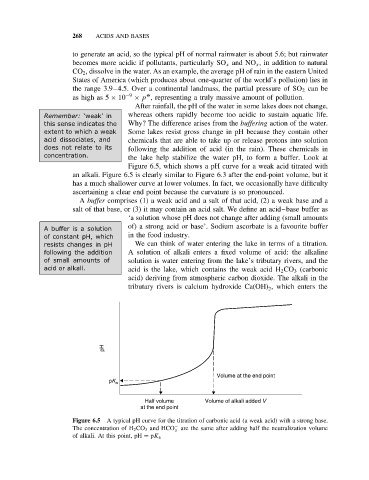
                                      Figure 6.5, which shows a pH curve for a weak acid titrated with
                      an alkali. Figure 6.5 is clearly similar to Figure 6.3 after the end-point volume, but it
                      has a much shallower curve at lower volumes. In fact, we occasionally have difficulty
                      ascertaining a clear end point because the curvature is so pronounced.
                        A buffer comprises (1) a weak acid and a salt of that acid, (2) a weak base and a
                      salt of that base, or (3) it may contain an acid salt. We define an acid–base buffer as
                                      ‘a solution whose pH does not change after adding (small amounts
              A buffer is a solution  of) a strong acid or base’. Sodium ascorbate is a favourite buffer
              of constant pH, which   in the food industry.
              resists changes in pH     We can think of water entering the lake in terms of a titration.
              following the addition  A solution of alkali enters a fixed volume of acid: the alkaline
              of small amounts of     solution is water entering from the lake’s tributary rivers, and the
              acid or alkali.         acid is the lake, which contains the weak acid H 2 CO 3 (carbonic
                                      acid) deriving from atmospheric carbon dioxide. The alkali in the
                                      tributary rivers is calcium hydroxide Ca(OH) , which enters the
                                                                               2


                               pH


                                                                Volume at the end point
                                 pK a

                                           Half volume       Volume of alkali added V
                                          at the end point
                      Figure 6.5 A typical pH curve for the titration of carbonic acid (a weak acid) with a strong base.
                                                    −
                      The concentration of H 2 CO 3 and HCO are the same after adding half the neutralization volume
                                                    3
                      of alkali. At this point, pH = pK a

