


Page 304 - Physical chemistry understanding our chemical world
P. 304
pH BUFFERS    271

             We can prepare a buffer of almost any pH provided we know the pK a of the acid; and
             such values are easily calculated from the K a values in Table 6.5 and in most books
             of physical chemistry and Equation (6.50). We first choose a weak acid whose pK a
             is relatively close to the buffer pH we want. We then need to measure out accurately
             the volume of acid and base solutions, as dictated by Equation (6.50).

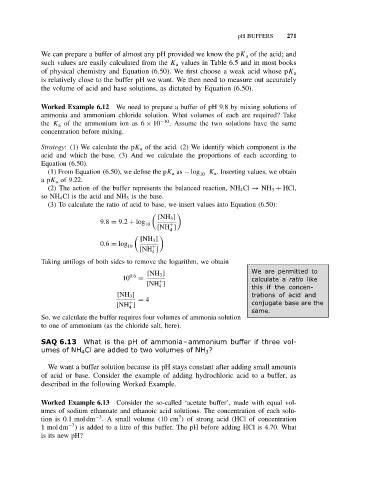
             Worked Example 6.12 We need to prepare a buffer of pH 9.8 by mixing solutions of
             ammonia and ammonium chloride solution. What volumes of each are required? Take
             the K a of the ammonium ion as 6 × 10 −10 . Assume the two solutions have the same
             concentration before mixing.

             Strategy: (1) We calculate the pK a of the acid. (2) We identify which component is the
             acid and which the base. (3) And we calculate the proportions of each according to
             Equation (6.50).
               (1) From Equation (6.50), we define the pK a as − log  K a . Inserting values, we obtain
                                                           10
             apK a of 9.22.
               (2) The action of the buffer represents the balanced reaction, NH 4 Cl → NH 3 + HCl,
             so NH 4 Cl is the acid and NH 3 is the base.
               (3) To calculate the ratio of acid to base, we insert values into Equation (6.50):
                                               [NH 3 ]

                              9.8 = 9.2 + log
                                           10     +
                                               [NH ]
                                                  4

                                          [NH 3 ]
                              0.6 = log 10
                                             +
                                          [NH ]
                                             4
             Taking antilogs of both sides to remove the logarithm, we obtain
                                            [NH 3 ]                       We are permitted to
                                     10 0.6  =                            calculate a ratio like
                                            [NH ]
                                               +
                                               4                          this if the concen-
                                   [NH 3 ]                                trations of acid and
                                         = 4
                                      +
                                   [NH ]                                  conjugate base are the
                                      4
                                                                          same.
             So, we calculate the buffer requires four volumes of ammonia solution
             to one of ammonium (as the chloride salt, here).
             SAQ 6.13 What is the pH of ammonia–ammonium buffer if three vol-
             umes of NH 4 Cl are added to two volumes of NH 3 ?
               We want a buffer solution because its pH stays constant after adding small amounts
             of acid or base. Consider the example of adding hydrochloric acid to a buffer, as
             described in the following Worked Example.

             Worked Example 6.13 Consider the so-called ‘acetate buffer’, made with equal vol-
             umes of sodium ethanoate and ethanoic acid solutions. The concentration of each solu-
                                                     3
                             −3
             tion is 0.1 mol dm . A small volume (10 cm ) of strong acid (HCl of concentration
                     −3
             1 mol dm ) is added to a litre of this buffer. The pH before adding HCl is 4.70. What
             is its new pH?

