


Page 339 - Physical chemistry understanding our chemical world
P. 339
306    ELECTROCHEMISTRY


                                   Conventional              Electrochromic
                                      mirror                    mirror

                                                 Incident beam          Incident beam


                                                 Emerging beam          Emerging beam


                                    Reflective               Reflective  Electrochromic
                                     surface                  surface  layers
                                       (a)                        (b)

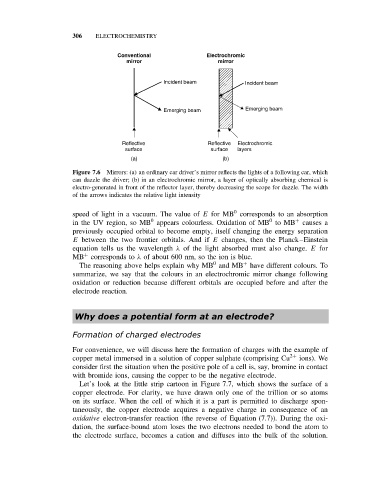
                      Figure 7.6 Mirrors: (a) an ordinary car driver’s mirror reflects the lights of a following car, which
                      can dazzle the driver; (b) in an electrochromic mirror, a layer of optically absorbing chemical is
                      electro-generated in front of the reflector layer, thereby decreasing the scope for dazzle. The width
                      of the arrows indicates the relative light intensity

                                                                     0
                      speed of light in a vacuum. The value of E for MB corresponds to an absorption
                                                                               0
                                             0
                                                                                       +
                      in the UV region, so MB appears colourless. Oxidation of MB to MB causes a
                      previously occupied orbital to become empty, itself changing the energy separation
                      E between the two frontier orbitals. And if E changes, then the Planck–Einstein
                      equation tells us the wavelength λ of the light absorbed must also change. E for
                         +
                      MB corresponds to λ of about 600 nm, so the ion is blue.
                                                               0
                        The reasoning above helps explain why MB and MB have different colours. To
                                                                        +
                      summarize, we say that the colours in an electrochromic mirror change following
                      oxidation or reduction because different orbitals are occupied before and after the
                      electrode reaction.

                       Why does a potential form at an electrode?

                      Formation of charged electrodes

                      For convenience, we will discuss here the formation of charges with the example of
                      copper metal immersed in a solution of copper sulphate (comprising Cu 2+  ions). We
                      consider first the situation when the positive pole of a cell is, say, bromine in contact
                      with bromide ions, causing the copper to be the negative electrode.
                        Let’s look at the little strip cartoon in Figure 7.7, which shows the surface of a
                      copper electrode. For clarity, we have drawn only one of the trillion or so atoms
                      on its surface. When the cell of which it is a part is permitted to discharge spon-
                      taneously, the copper electrode acquires a negative charge in consequence of an
                      oxidative electron-transfer reaction (the reverse of Equation (7.7)). During the oxi-
                      dation, the surface-bound atom loses the two electrons needed to bond the atom to
                      the electrode surface, becomes a cation and diffuses into the bulk of the solution.

