


Page 338 - Physical chemistry understanding our chemical world
P. 338
INTRODUCING HALF-CELLS AND ELECTRODE POTENTIALS      305

             SAQ 7.11 Write down an expression for the electrode potential of the
             bromine | bromide couple. [Hint: it might help to write the balanced redox
             reaction first.]


              How do ‘electrochromic’ car mirrors work?

             Introducing an orbital approach to dynamic electrochemistry
             It’s quite common when driving at night to be dazzled by the
                                                                          Electrochromic mirrors
             lights of the vehicle behind as they reflect from the driver’s new-
                                                                          are now a common
             view or door mirror. We can prevent the dazzle by forming a
                                                                          feature in expensive
             layer of coloured material over the reflecting surface within an
                                                                          cars.
             electrochromic mirror. Such mirrors are sometimes called ‘smart
             mirrors’ or electronic ‘anti-dazzle mirrors’.
               These mirrors are electrochromic if they contain a substance that changes colour
                                                                  +
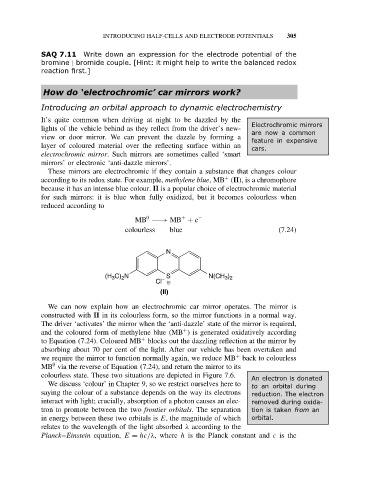
             according to its redox state. For example, methylene blue,MB (II), is a chromophore
             because it has an intense blue colour. II is a popular choice of electrochromic material
             for such mirrors: it is blue when fully oxidized, but it becomes colourless when
             reduced according to
                                            0
                                                      +
                                        MB −−→ MB + e      −
                                     colourless   blue                            (7.24)

                                                 N


                               (H 3 C) 2 N       S            N(CH 3 ) 2
                                              Cl −
                                                (II)

               We can now explain how an electrochromic car mirror operates. The mirror is
             constructed with II in its colourless form, so the mirror functions in a normal way.
             The driver ‘activates’ the mirror when the ‘anti-dazzle’ state of the mirror is required,
                                                      +
             and the coloured form of methylene blue (MB ) is generated oxidatively according
             to Equation (7.24). Coloured MB blocks out the dazzling reflection at the mirror by
                                          +
             absorbing about 70 per cent of the light. After our vehicle has been overtaken and
                                                                     +
             we require the mirror to function normally again, we reduce MB back to colourless
                0
             MB via the reverse of Equation (7.24), and return the mirror to its
             colourless state. These two situations are depicted in Figure 7.6.
                                                                          An electron is donated
               We discuss ‘colour’ in Chapter 9, so we restrict ourselves here to  to an orbital during
             saying the colour of a substance depends on the way its electrons  reduction. The electron
             interact with light; crucially, absorption of a photon causes an elec-  removed during oxida-
             tron to promote between the two frontier orbitals. The separation  tion is taken from an
             in energy between these two orbitals is E, the magnitude of which  orbital.
             relates to the wavelength of the light absorbed λ according to the
             Planck–Einstein equation, E = hc/λ, where h is the Planck constant and c is the

