


Page 340 - Physical chemistry understanding our chemical world
P. 340
INTRODUCING HALF-CELLS AND ELECTRODE POTENTIALS      307


                                     Surface atom              Positive ion
                                                                 (cation)

                                                        −    + +
                                                        −


                            Electrode                   Excess surface charge

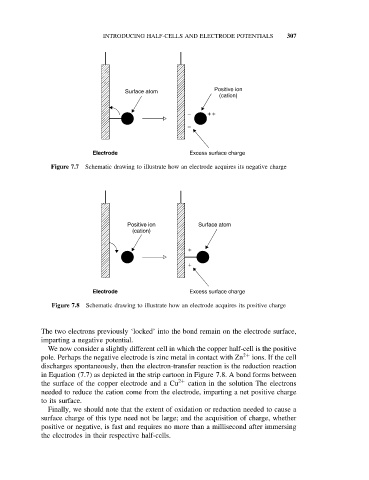
                Figure 7.7  Schematic drawing to illustrate how an electrode acquires its negative charge


                                      Positive ion         Surface atom
                                       (cation)

                                                        +
                                                        +


                            Electrode                   Excess surface charge

                Figure 7.8  Schematic drawing to illustrate how an electrode acquires its positive charge


             The two electrons previously ‘locked’ into the bond remain on the electrode surface,
             imparting a negative potential.
               We now consider a slightly different cell in which the copper half-cell is the positive
             pole. Perhaps the negative electrode is zinc metal in contact with Zn 2+  ions. If the cell
             discharges spontaneously, then the electron-transfer reaction is the reduction reaction
             in Equation (7.7) as depicted in the strip cartoon in Figure 7.8. A bond forms between
             the surface of the copper electrode and a Cu 2+  cation in the solution The electrons
             needed to reduce the cation come from the electrode, imparting a net positive charge
             to its surface.
               Finally, we should note that the extent of oxidation or reduction needed to cause a
             surface charge of this type need not be large; and the acquisition of charge, whether
             positive or negative, is fast and requires no more than a millisecond after immersing
             the electrodes in their respective half-cells.

