


Page 335 - Physical chemistry understanding our chemical world
P. 335
302    ELECTROCHEMISTRY

                      constituent parts, so Na(Hg) is solid and, when prepared with certain concentrations
                      of sodium, does not even react with water.


                       Why is electricity more dangerous in wet weather?

                      Electrolytes for cells, and introducing ions

                      Most electrical apparatus is safe when operated in a dry environment, but everyone
                      should know that water and electricity represent a lethal combination. Only a minimal
                      amount of charge conducts through air, so cutting dry grass with an electric mower
                      is safe. Cutting the same grass during a heavy downpour risks electrocution, because
                      water is a good conductor of electricity.
                                        But water does not conduct electrons, so the charges must move
              Currents conduct        through water by a wholly different mechanism than through a
              throughanelectrolyte    metallic electrode. In fact, the charge carriers through solutions –
              by means of ions.       aqueous or otherwise – are solvated ions. The ‘mobility’ µ of an
                                      ion in water is sufficiently high that charge conducts rapidly from
                                      a wet electrical appliance toward the person holding it: it behaves
              Ultimately, the word    as an electrolyte.
              ‘ion’ derives from the
              Greek eimi ‘to go’,       All cells comprise half-cells, electrodes and a conductive elec-
              implying the arrival of  trolyte; the latter component separates the electrodes and conducts
              someone or something.   ions. It is usually, although not always, a liquid and normally has
              We get the English      an ionic substance dissolved within it, the solid dissociating in
              word ‘aim’ from this    solution to form ions. Aqueous electrolytes are a favourite choice
              root.                   because the high ‘dielectric constant’   of water imparts a high
                                      ‘ionic conductivity’ κ to the solution.
                                        Sometimes electrochemists are forced to construct electrochem-
              Ionic conductivity is   ical cells without water, e.g. if the analyte is water sensitive or
              often given the Greek   merely insoluble. In these cases, we construct the cell with an
              symbol kappa (κ)        organic solvent, the usual choice being the liquids acetonitrile,
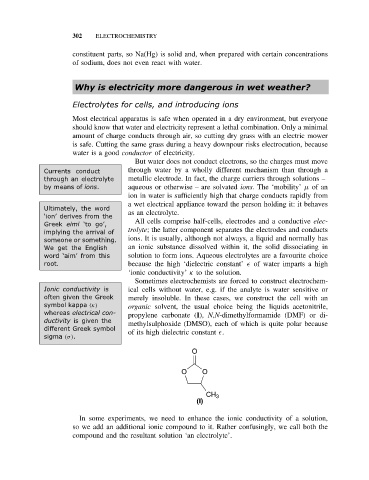
              whereas electrical con-  propylene carbonate (I), N,N-dimethylformamide (DMF) or di-
              ductivity is given the  methylsulphoxide (DMSO), each of which is quite polar because
              different Greek symbol  of its high dielectric constant  .
              sigma (σ).

                                                         O


                                                      O     O


                                                             CH 3
                                                          (I)
                        In some experiments, we need to enhance the ionic conductivity of a solution,
                      so we add an additional ionic compound to it. Rather confusingly, we call both the
                      compound and the resultant solution ‘an electrolyte’.

