


Page 331 - Physical chemistry understanding our chemical world
P. 331
298    ELECTROCHEMISTRY

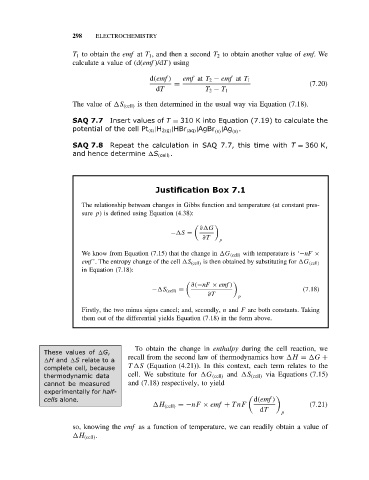
                      T 1 to obtain the emf at T 1 , and then a second T 2 to obtain another value of emf.We
                      calculate a value of (d(emf )/dT )using

                                             d(emf )  emf at T 2 − emf at T 1
                                                    =                                      (7.20)
                                              dT             T 2 − T 1
                      The value of  S (cell) is then determined in the usual way via Equation (7.18).

                      SAQ 7.7 Insert values of T = 310 K into Equation (7.19) to calculate the
                      potential of the cell Pt (s) |H 2(g) |HBr (aq) |AgBr |Ag .
                                                               (s)  (s)
                      SAQ 7.8 Repeat the calculation in SAQ 7.7, this time with T = 360 K,
                      and hence determine  S (cell) .


                                              Justification Box 7.1

                         The relationship between changes in Gibbs function and temperature (at constant pres-
                         sure p) is defined using Equation (4.38):

                                                           ∂ G

                                                   − S =
                                                            ∂T
                                                                 p
                         We know from Equation (7.15) that the change in  G (cell) with temperature is ‘−nF ×
                         emf ’. The entropy change of the cell  S (cell) is then obtained by substituting for  G (cell)
                         in Equation (7.18):

                                                        ∂(−nF × emf )

                                             − S (cell) =                                (7.18)
                                                             ∂T       p
                         Firstly, the two minus signs cancel; and, secondly, n and F are both constants. Taking
                         them out of the differential yields Equation (7.18) in the form above.


                                        To obtain the change in enthalpy during the cell reaction, we
              These values of  G,
               H and  S relate to a   recall from the second law of thermodynamics how  H =  G +
              complete cell, because  T S (Equation (4.21)). In this context, each term relates to the
              thermodynamic data      cell. We substitute for  G (cell) and  S (cell) via Equations (7.15)
              cannot be measured      and (7.18) respectively, to yield
              experimentally for half-

              cellsalone.                                                  d(emf )
                                              H (cell) =−nF × emf + TnF                    (7.21)
                                                                            dT     p
                      so, knowing the emf as a function of temperature, we can readily obtain a value of
                       H (cell) .

