


Page 332 - Physical chemistry understanding our chemical world
P. 332
INTRODUCTION TO CELLS: TERMINOLOGY AND BACKGROUND        299


                                                     2+
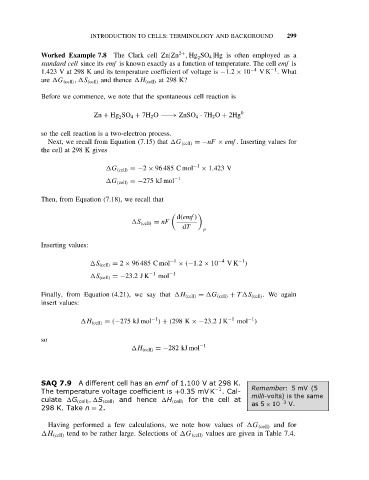
             Worked Example 7.8 The Clark cell Zn|Zn , Hg SO 4 |Hg is often employed as a
                                                          2
             standard cell since its emf is known exactly as a function of temperature. The cell emf is
                                                                                −1
             1.423 V at 298 K and its temperature coefficient of voltage is −1.2 × 10 −4  VK .What
             are  G (cell) , S (cell) and thence  H (cell) at 298 K?
             Before we commence, we note that the spontaneous cell reaction is

                            Zn + Hg SO 4 + 7H 2 O −−−→ ZnSO 4 · 7H 2 O + 2Hg 0
                                    2

             so the cell reaction is a two-electron process.
               Next, we recall from Equation (7.15) that  G (cell) =−nF × emf . Inserting values for
             the cell at 298 K gives

                                 G (cell) =−2 × 96 485 C mol −1  × 1.423 V
                                 G (cell) =−275 kJ mol −1


             Then, from Equation (7.18), we recall that


                                                    d(emf )
                                        S (cell) = nF
                                                      dT
                                                            p
             Inserting values:

                                                                      −1
                            S (cell) = 2 × 96 485 C mol −1  × (−1.2 × 10 −4  VK )
                            S (cell) =−23.2J K −1  mol −1

             Finally, from Equation (4.21), we say that  H (cell) =  G (cell) + T S (cell) .Weagain
             insert values:


                                             −1
                                                                         −1
                         H (cell) = (−275 kJ mol ) + (298 K ×−23.2J K −1  mol )
             so
                                        H (cell) =−282 kJ mol −1


             SAQ 7.9 A different cell has an emf of 1.100 V at 298 K.
             The temperature voltage coefficient is +0.35 mV K  −1 .Cal-   Remember:5 mV (5
             culate  G (cell) , S (cell) and hence  H (cell) for the cell at  milli-volts) is the same
                                                                                  −3
             298 K. Take n = 2.                                           as 5 × 10  V.
               Having performed a few calculations, we note how values of  G (cell) and for
              H (cell) tend to be rather large. Selections of  G (cell) values are given in Table 7.4.

