


Page 330 - Physical chemistry understanding our chemical world
P. 330
INTRODUCTION TO CELLS: TERMINOLOGY AND BACKGROUND        297


                        1.45
                                             Gradient = ‘temperature
                                               voltage coefficient’
                        1.44

                       emf/ V  1.43


                        1.42


                        1.41
                           280       290       300      310       320       330
                                              Temperature T/K
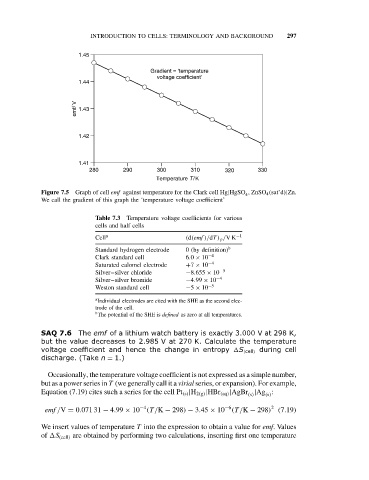
             Figure 7.5 Graph of cell emf against temperature for the Clark cell Hg|HgSO , ZnSO 4 (sat’d)|Zn.
                                                                        4
             We call the gradient of this graph the ‘temperature voltage coefficient’

                             Table 7.3  Temperature voltage coefficients for various
                             cells and half cells

                             Cell a                    (d(emf )/dT) p /VK −1
                             Standard hydrogen electrode  0 (by definition) b
                             Clark standard cell       6.0 × 10 −4
                             Saturated calomel electrode  +7 × 10 −4
                             Silver–silver chloride    −8.655 × 10 −5
                             Silver–silver bromide     −4.99 × 10 −4
                             Weston standard cell      −5 × 10 −5
                             a Individual electrodes are cited with the SHE as the second elec-
                             trode of the cell.
                             b The potential of the SHE is defined as zero at all temperatures.


             SAQ 7.6 The emf of a lithium watch battery is exactly 3.000 V at 298 K,
             but the value decreases to 2.985 V at 270 K. Calculate the temperature
             voltage coefficient and hence the change in entropy  S (cell) during cell
             discharge. (Take n = 1.)

               Occasionally, the temperature voltage coefficient is not expressed as a simple number,
             but as a power series in T (we generally call it a virial series, or expansion). For example,
             Equation (7.19) cites such a series for the cell Pt (s) |H 2(g) |HBr (aq) |AgBr |Ag :
                                                                         (s)  (s)

                                                                                2
                                                                  −6
                                          −4
              emf /V = 0.071 31 − 4.99 × 10 (T/K − 298) − 3.45 × 10 (T/K − 298) (7.19)
             We insert values of temperature T into the expression to obtain a value for emf. Values
             of  S (cell) are obtained by performing two calculations, inserting first one temperature

