


Page 333 - Physical chemistry understanding our chemical world
P. 333
300    ELECTROCHEMISTRY

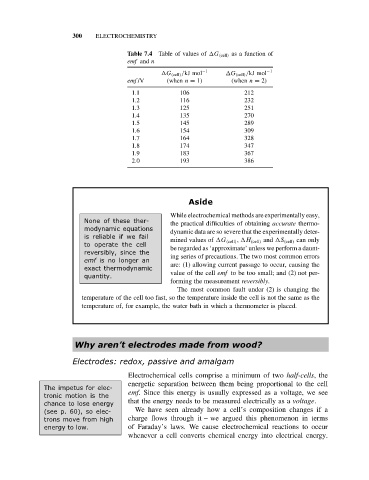
                                      Table 7.4  Table of values of  G (cell) as a function of
                                      emf and n
                                                 G (cell) /kJ mol −1   G (cell) /kJ mol −1
                                      emf /V      (when n = 1)      (when n = 2)
                                       1.1           106                212
                                       1.2           116                232
                                       1.3           125                251
                                       1.4           135                270
                                       1.5           145                289
                                       1.6           154                309
                                       1.7           164                328
                                       1.8           174                347
                                       1.9           183                367
                                       2.0           193                386


                                                        Aside
                                                  While electrochemical methods are experimentally easy,
                         None of these ther-      the practical difficulties of obtaining accurate thermo-
                         modynamic equations      dynamic data are so severe that the experimentally deter-
                         is reliable if we fail
                                                  mined values of  G (cell) , H (cell) and  S (cell) can only
                         to operate the cell      be regarded as ‘approximate’ unless we perform a daunt-
                         reversibly, since the
                                                  ing series of precautions. The two most common errors
                         emf is no longer an
                         exact thermodynamic      are: (1) allowing current passage to occur, causing the
                                                  value of the cell emf to be too small; and (2) not per-
                         quantity.
                                                  forming the measurement reversibly.
                                                    The most common fault under (2) is changing the
                         temperature of the cell too fast, so the temperature inside the cell is not the same as the
                         temperature of, for example, the water bath in which a thermometer is placed.


                       Why aren’t electrodes made from wood?

                      Electrodes: redox, passive and amalgam

                                      Electrochemical cells comprise a minimum of two half-cells,the
                                      energetic separation between them being proportional to the cell
              The impetus for elec-
              tronic motion is the    emf. Since this energy is usually expressed as a voltage, we see
                                      that the energy needs to be measured electrically as a voltage.
              chance to lose energy
              (see p. 60), so elec-     We have seen already how a cell’s composition changes if a
              trons move from high    charge flows through it – we argued this phenomenon in terms
              energy to low.          of Faraday’s laws. We cause electrochemical reactions to occur
                                      whenever a cell converts chemical energy into electrical energy.

