


Page 267 - Physical Chemistry
P. 267
lev38627_ch08.qxd  3/14/08  12:54 PM  Page 248


                248
               Chapter 8
               Real Gases

               Figure 8.4
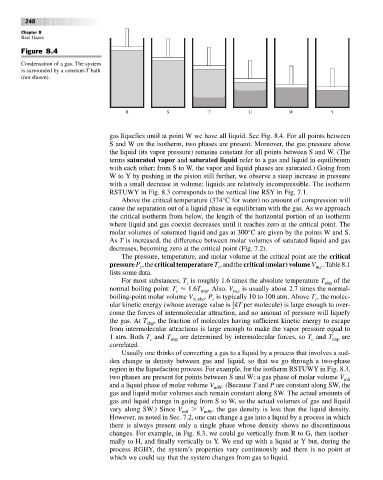
               Condensation of a gas. The system
               is surrounded by a constant-T bath
               (not shown).


                                              R           S            T           U           W           Y


                                         gas liquefies until at point W we have all liquid. See Fig. 8.4. For all points between
                                         S and W on the isotherm, two phases are present. Moreover, the gas pressure above
                                         the liquid (its vapor pressure) remains constant for all points between S and W. (The
                                         terms saturated vapor and saturated liquid refer to a gas and liquid in equilibrium
                                         with each other; from S to W, the vapor and liquid phases are saturated.) Going from
                                         W to Y by pushing in the piston still further, we observe a steep increase in pressure
                                         with a small decrease in volume; liquids are relatively incompressible. The isotherm
                                         RSTUWY in Fig. 8.3 corresponds to the vertical line RSY in Fig. 7.1.
                                             Above the critical temperature (374°C for water) no amount of compression will
                                         cause the separation out of a liquid phase in equilibrium with the gas. As we approach
                                         the critical isotherm from below, the length of the horizontal portion of an isotherm
                                         where liquid and gas coexist decreases until it reaches zero at the critical point. The
                                         molar volumes of saturated liquid and gas at 300°C are given by the points W and S.
                                         As T is increased, the difference between molar volumes of saturated liquid and gas
                                         decreases, becoming zero at the critical point (Fig. 7.2).
                                             The pressure, temperature, and molar volume at the critical point are the critical
                                         pressureP ,thecriticaltemperatureT ,andthecritical(molar)volumeV .Table8.1
                                                  c                       c                            m,c
                                         lists some data.
                                             For most substances, T is roughly 1.6 times the absolute temperature T  of the
                                                                c                                         nbp
                                         normal boiling point: T   1.6T  . Also, V  is usually about 2.7 times the normal-
                                                             c      nbp       m,c
                                         boiling-point molar volume V  . P is typically 10 to 100 atm. Above T , the molec-
                                                                  m,nbp  c                             c
                                                                              3
                                         ular kinetic energy (whose average value is  kT per molecule) is large enough to over-
                                                                              2
                                         come the forces of intermolecular attraction, and no amount of pressure will liquefy
                                         the gas. At T  , the fraction of molecules having sufficient kinetic energy to escape
                                                    nbp
                                         from intermolecular attractions is large enough to make the vapor pressure equal to
                                         1 atm. Both T and T  are determined by intermolecular forces, so T and T  are
                                                     c      nbp                                       c     nbp
                                         correlated.
                                             Usually one thinks of converting a gas to a liquid by a process that involves a sud-
                                         den change in density between gas and liquid, so that we go through a two-phase
                                         region in the liquefaction process. For example, for the isotherm RSTUWY in Fig. 8.3,
                                         two phases are present for points between S and W: a gas phase of molar volume V
                                                                                                               mS
                                         and a liquid phase of molar volume V  . (Because T and P are constant along SW, the
                                                                        mW
                                         gas and liquid molar volumes each remain constant along SW. The actual amounts of
                                         gas and liquid change in going from S to W, so the actual volumes of gas and liquid
                                         vary along SW.) Since V    V   , the gas density is less than the liquid density.
                                                               mS    mW
                                         However, as noted in Sec. 7.2, one can change a gas into a liquid by a process in which
                                         there is always present only a single phase whose density shows no discontinuous
                                         changes. For example, in Fig. 8.3, we could go vertically from R to G, then isother-
                                         mally to H, and finally vertically to Y. We end up with a liquid at Y but, during the
                                         process RGHY, the system’s properties vary continuously and there is no point at
                                         which we could say that the system changes from gas to liquid.

