


Page 286 - Pipeline Risk Management Manual Ideas, Techniques, and Resources
P. 286
Station risk assessment  131263
              Model design                               Table 13.1  Typical database fields for risk variables
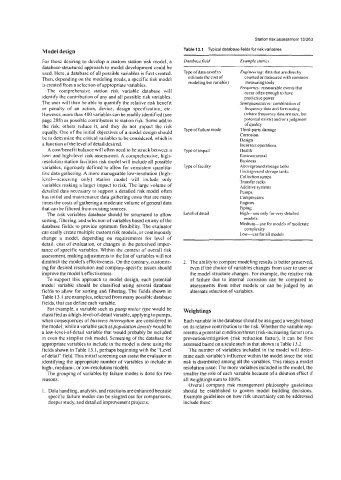
              For those desiring to develop a custom  station risk model,  a   Database,  field   Example entries
              database-structured approach to model development could be
              used. Here, a database of all possible variables is first created.   Type of data (used to   Engineering: data that are directly
              Then, depending on the modeling needs, a specific risk model   estimate the cost of   counted or measured with common
              is created from a selection of appropriate variables.   modeling the variable)   measuring tools
               The  comprehensive  station  risk  variable  database  will   Frcquenq: measurable events that
                                                                           occur often enough to have
              identify the contribution of any and all possible risk variables.   predictive power
              The user will then be able to quantify the relative risk benefit   Semiquantitative: combination  of
              or  penalty  of  an  action,  device,  design  specification,  etc.   frequency data and forecasting
              However, more than 400 variables can be readily identified (see   (where frequency data are rare, but
              page 288) as possible contributors to station risk. Some add to   potential exists) and/or ajudgment
              the risk,  others  reduce  it,  and  they  do not  impact  the  risk   of quality
              equally. One of the initial objectives of a model design should   Type of failure mode   Third-party damage
                                                                          Corrosion
              be to determine the critical variables to be considered, which is   Design
              a function ofthe level of detail desired.                   Incorrect operations
               A costhenefit balance will often need to be struck between a   Type of impact   Health
              low- and high-level risk assessment. A comprehensive, high-   Environmental
              resolution station facilities risk model will include all possible   Business
              variables, rigorously defined to allow for consistent quantita-   Type offacility   Aboveground storage tanks
              tive data gathering. A more manageable low-resolution (high-   Underground storage tanks
              level-screening   only)  station  model  will  include  only   Collection sumps
                                                                          Transfer racks
              variables making a larger impact to risk. The large volume of   Additive systems
              detailed data necessary to support a detailed risk model often   Pumps
              has initial and maintenance data gathering costs that are many   Compressors
              times the costs of gathering a moderate volume of general data   Engines
             that can be filtered from existing sources.                  Piping
               The risk variables  database  should be  structured  to allow   Level of detail   High-se   only for very detailed
              sorting, filtering, and selection of variables based on any of the   models
              database fields to provide optimum flexibility. The evaluator   Medium-use  for models of moderate
                                                                           complexity
              can easily create multiple custom risk models, or continuously   Low-use  for all models
              change  a  model,  depending  on  requirements  for  level  of
              detail, cost of evaluation, or changes in the perceived impor-
             tance of specific variables. Within  the context of overall risk
              assessment, making adjustments to the list of variables will not
              diminish the model’s effectiveness. On the contrary, customiz-   2.  The ability to compare modeling results is better preserved,
              ing for desired resolution and company-specific issues should   even if the choice of variables changes from user to user or
              improve the model’s effectiveness.           the model structure changes. For example, the relative risk
               To support this approach  to model design,  each potential   of failure  due to internal  corrosion  can be  compared  to
             model  variable  should  be  classified using  several  database   assessments  from other models  or can  be judged  by  an
             fields to allow for sorting and filtering. The fields shown in   alternate selection of variables.
             Table 13.1 are examples, selected from many possible database
              fields, that can define each variable.
               For example, a variable such as pump motor type would be   Weightings
             classified as a high-level-of-detail variable, applying to pumps,
             when consequences of business interruption are considered in   Each variable in the database should be assigned a weight based
             the model; while a variable such aspopulation density would be   on its relative contribution to the risk. Whether the variable rep-
             a low-level-of-detail variable that would probably be included   resents a potential conditiodthreat (risk-increasing factor) or a
              in even the simplist risk model. Screening of the database for   preventiodmitigation (risk  reduction  factor),  it  can  be  first
              appropriate variables to include in the model is done using the   assessed based on a scale such as that shown inTable 13.2.
              fields shown in Table 13.1, perhaps beginning with the “Level   The number of variables included in the model will deter-
             of detail” field. This initial screening can assist the evaluator in   mine each variable’s influence within the model since the total
             identifying the appropriate number of variables to include in   risk is distributed among all the variables. This raises a model
             high-, medium-, or low-resolution models.   resolution issue: The more variables included in the model, the
               The grouping of variables by failure modes is done for two   smaller the role of each variable because of a dilution effect if
             reasons:                                   all weightings sum to 100%.
                                                          Overall company  risk  management  philosophy  guidelines
              I,  Data handling, analysis, and reactions are enhanced because   should  be  established  to  govern  model  building  decisions.
               specific failure modes can be singled out for comparisons,   Example guidelines on how risk uncertainty can be addressed
               deeper study, and detailed improvement projects.   include these:

