


Page 288 - Pipeline Risk Management Manual Ideas, Techniques, and Resources
P. 288
Risk assessment model 13/265
              the most part aboveground, such as terminals, tank farms, and   Incorrect Operations Index
              pump stations, and are usually  on  property  completely  con-   A. Design
              trolled by the owner, the approach described in those chapters   B.  Construction
              should be somewhat modified. Some suggested modifications   C. Operations
              are designed to better capture the risks unique to surface facili-   D.  Maintenance
              ties, while maintaining  a direct comparability between these
              facilities and the pipe-only portions of the pipeline system. The   Leak Impact Factor
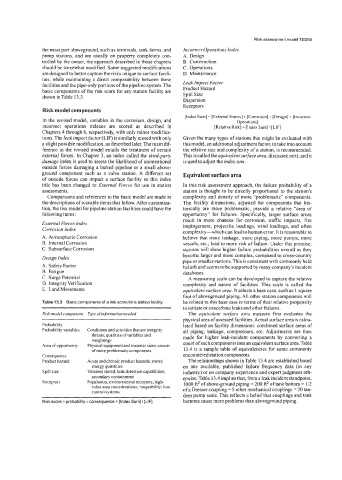
              basic components of the risk score for any station facility are   Product Hazard
              showninTable 13.3.                         Spill Size
                                                         Dispersion
                                                         Receptors
              Risk model components
                                                         [Index Sum] = [External Forces] + [Corrosion] +[Design] + [Incorrect
              In the revised model,  variables in the corrosion, design, and   Operations]
              incorrect  operations  indexes  are  scored  as  described  in   [Relative Risk] = [Index Sum] / [LIF]
              Chapters 4 through 6, respectively, with only minor modifica-
              tions. The leak impact factor (LIF) is similarly scored with only   Given the many types of stations that might be evaluated with
              a slight possible modification, as described later. The main dif-   this model, an additional adjustment factor, to take into account
              ference in the revised model entails the treatment of certain   the relative size and complexity of a station, is recommended.
              external forces. In Chapter 3, an index called the third-party   This is called the equivalent surface area, discussednext, and it
              damage index is used to assess the likelihood of unintentional   is used to adjust the index sum.
              outside forces damaging a buried pipeline or  a small above-
              ground  component  such  as  a valve  station.  A  different  set   Equivalent surface area
              of  outside  forces can impact  a surface  facility  so this index
              title has been  changed  to External  Forces for use  in station   In this risk assessment approach, the failure probability  of a
              assessments.                               station is thought to be directly proportional  to the station’s
               Comparisons and references to the basic model are made in   complexity  and density of more “problematic”  components.
              the descriptions of scorable items that follow. After customiza-   The  facility  dimensions,  adjusted  for components that  his-
              tion, the risk model for pipeline station facilities could have the   torically  are  more  problematic,  provide  a  relative  “area  of
              following items:                           opportunity”  for  failures.  Specifically,  larger  surface areas
                                                         result  in  more  chances  for  corrosion, traffic  impacts,  fire
              External Forces Index                      impingement, projectile  loadings,  wind  loadings,  and  often
              Corrosion Index                            complexity-which  can lead to human error. It is reasonable to
              A. Atmospheric Corrosion                   believe that more tankage,  more piping,  more pumps, more
              B.  Internal Corrosion                     vessels, etc., lead to more risk of failure. Under this premise,
              C. Subsurface Corrosion                    stations will show higher failure probabilities  overall as they
              Design Index                               become larger and more complex, compared to cross-country
                                                         pipe or smaller stations. This is consistent with commonly held
              A. Safety Factor                           beliefs and seems to be supported by many company’s incident
              B.  Fatigue                                databases.
              C. Surge Potential                          A measuring scale can be developed to capture the relative
              D. Integrity Verification                  complexity  and  nature  of  facilities. This scale is  called  the
              E. Land Movements                          equivalent surface area. It selects a base case, such as 1 square
                                                         foot of aboveground piping. All other station components will
              Table 13.3  Basic components of a risk score for a station facility   be related to this base case in terms of their relative propensity
                                                         to initiate or exacerbate leaks and other failures.
              Risk model component  @pe of informution needed   The  equivalent  surface  area  measure  first  evaluates  the
                                                         physical area of assessed facilities. Actual surface area is calcu-
              Probability                                lated based on facility dimensions: combined surface areas of
              Probability vanables   Conditions and activities that are integrity   all piping,  tankage,  compressors,  etc. Adjustments  are  then
                             threats; qualities ofvariables and   made  for  higher  leak-incident  components  by  converting  a
                             weightings
              Area of opportunity   Physical equipment and material sizes; counts   count of such components into an equivalent surface area. Table
                             of more problematic components   13.4 is  a sample table  of equivalencies for some commonly
              Consequence                                encountered station components.
              Product hazard   Acute and chronic product hazards; stored   The relationships shown in Table 13.4 are established based
                             energy quantities           on  any  available, published  failure  frequency  data  (in  any
              Spill size   Volumes stored; leak detection capabilities;   industry) or on company experience and expert judgment oth-
                             secondary containment       erwise. Table 13.4 implies that, from a leak incident standpoint,
              Receptors    Population, environmental receptors, high-   1000 ft2 of above-ground piping = 200 fiz of tank bottom = 1/2
                             value area considerations; rangeability; loss
                             control systems             of a Dresser coupling = 5 other mechanical couplings = 20 tan-
                                                         dem pump seals. This reflects a belief that couplings and tank
              Risk score = probability x consequence = [Index Sum] / [LIF]   bottoms cause more problems than aboveground piping.

