


Page 363 - Pipeline Risk Management Manual Ideas, Techniques, and Resources
P. 363
151338 Risk Management
                      Consequence (receptor)                       Probability
                                                                                ~~~   ~~~   ~
                                                  Never   Has      Has      Happens  Happens
                                                  heard of in  occurred  occurred   several   several
                                                  industry   in industry  in company  times per  times per
                                                                            year in T year in

             No health  No     No effect   No impact
             effect   damage

             Minor    Minor     Minor     Limited
             injury   damage    effect    impact
             potential


             Major   Localized   Localized  Considerable
             injury   damage   effect   impact
             potential

             Fatality   Major   Major    National
                      damage    effect   impact


             Multiple   Extensive   Massive   International
             fatalities 1 damage  I  effect  I impact


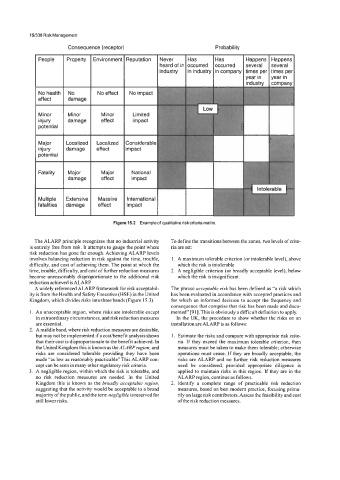
                                    Figure 15.2  Example of qualitative risk criteria matrix.

            The ALARF’ principle recognizes that no industrial activity   To define the transitions between the zones, two levels of crite-
          is entirely free from risk. It attempts to gauge the point where   ria are set:
          risk reduction has gone far enough. Achieving  ALARF’ levels
          involves balancing reduction in risk against the time, trouble,   1. A maximum tolerable criterion (or intolerable level), above
          difficulty, and cost of achieving them. The point at which the   which the risk is intolerable
          time, trouble, difficulty, and cost of further reduction measures   2.  A negligible criterion (or broadly acceptable level), below
          become unreasonably disproportionate to the additional risk   which the risk is insignificant.
          reduction achieved is ALARP
            A widely referenced  ALARP framework for risk acceptabil-   The phrase acceptable risk has been defined as “a risk which
          ity is from the Health and Safety Executive (HSE) in the United   has been evaluated in accordance with accepted practices and
          Kingdom, which divides risks into three bands (Figure 15.3).   for which an informed decision to accept the frequency and
                                                     consequence that comprise that risk has been made and docu-
          1.  An unacceptable region, where risks are intolerable except   mented” [91]. This is obviously a difficult definition to apply.
            in extraordinary circumstances, and risk reduction measures   In the UK, the procedure to show whether the risks on an
            are essential.                           installation are ALARF’ is as follows:
          2.  A middle band, where risk reduction measures are desirable,
            but may not be implemented if a costhenefit analysis shows   1.  Estimate the risks and compare with appropriate risk crite-
            that their cost is disproportionate to the benefit achieved. In   ria. If they exceed the maximum tolerable criterion, then
            the United Kingdom this is known as the ALARP region, and   measures must be taken to make them tolerable; otherwise
            risks are  considered tolerable providing they  have  been   operations must cease. If they are broadly acceptable, the
            made “as low as reasonably practicable” This ALARF’ con-   risks are ALARP and no further risk reduction measures
            cept can be seen in many other regulatory risk criteria.   need  be  considered,  provided  appropriate  diligence  is
          3.  A negligible region, within which the risk is tolerable, and   applied to maintain risks in this region. If they are in the
            no  risk  reduction  measures  are  needed.  In  the  United   ALARF’ region, continue as follows.
            Kingdom this is known as the broadly acceptable region,   2.  Identify  a  complete range  of  practicable risk  reduction
            suggesting that the activity would be acceptable to a broad   measures, based on best modern practice, focusing prima-
            majority ofthe public, and the term negligible is reserved for   rily on large risk contributors. Assess the feasibility and cost
            still lower risks.                         of the risk reduction measures.

