


Page 366 - Pipeline Risk Management Manual Ideas, Techniques, and Resources
P. 366
Decision points 15/341
              Other structures                           Table 15.5  Reliability levelsfor offshore structures (CANCSA-
                                                         S471-92, Appendix A)
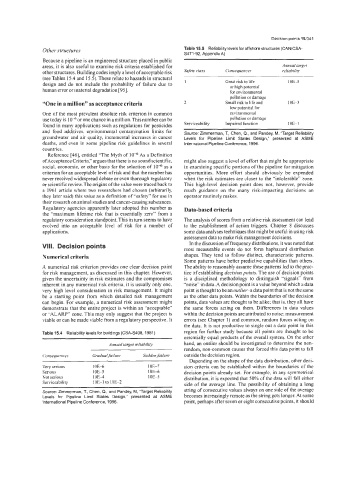
              Because a pipeline is an engineered structure placed in public
              areas, it is also useful to examine risk criteria established for        Annual target
              other structures. Building codes imply a level of acceptable risk   Safer?, class   Consequence7   reliahdrh
              (see Tables 15.4 and 15.5). These relate to hazards in structural
              design  and  do not  include  the probability  of  failure  due to   1   Great risk to life   1 OE -5
                                                                       or high potential
              human error or material degradation [95].                for environmental
                                                                       pollution or damage
              “One in a million” as acceptance criteria   2           Small risk to life and   1 OE-3
                                                                       low potential for
              One of the most prevalent absolute risk criterion in common   environmental
              use today is   or one chance in a million. This number can be   pollution or damage
              found in many applications such as regulations for pesticides   Serviceability   Impaired function   lOE-l
              and  food  additives,  environmental  contamination  limits  for   Source: Zimmerman, T, Chen, Q., and Pandey, M. “Target Reliability
              groundwater  and air quality, incremental increases in cancer   Levels  for  Pipeline  Limit  States  Design,” presented  at  ASME
              deaths,  and even in some pipeline  risk guidelines  in several   International Pipeline Conference, 1996.
              countries.
                Reference [46],  entitled “The Myth of   As a Definition
              ofAcceptance Criteria,” argues that there is no sound scientific,   might also suggest a level of effort that might be appropriate
              social, economic, or other basis for the selection of   as a   in examining specific portions of the pipeline for mitigation
              criterion for an acceptable level of risk and that the number has   opportunities.  More  effort  should  obviously  be  expended
              never received widespread debate or even thorough regulatory   when the risk estimates are closer to the “intolerable” zone.
              or scientific review. The origins ofthe value were traced back to   This  high-level  decision point  does  not,  however, provide
              a  1961 article where two researchers  had chosen (arbitrarily,   much  guidance  on  the  many  risk-impacting  decisions  an
              they later said) this value as a definition of “safety” for use in   operator routinely makes.
              their research on animal studies and cancer-causing substances.
              Regulatory  agencies apparently later adopted this number as   Data-based criteria
              the  “maximum  lifetime risk  that  is essentially zero”  from  a
              regulatory consideration standpoint. This in turn seems to have   The analysis of scores from a relative risk assessment can lead
              evolved  into  an  acceptable  level  of  risk  for  a  number  of   to the  establishment  of  action  triggers.  Chapter  8  discusses
              applications.                              some data analyses techniques that might be useful in using risk
                                                         assessment data to make risk management decisions.
                                                           In the discussion of frequency distributions, it was noted that
              VIII.  Decision points                     most  measurable  events do not  form  haphazard  distribution
              Numerical criteria                         shapes. They tend  to  follow distinct,  characteristic  patterns.
                                                         Some patterns have better predictive capabilities than others.
              A numerical risk criterion provides one clear decision point   The ability to reasonably assume these patterns led to the prac-
              for risk management, as discussed in this chapter. However,   tice of establishing decision points. The use of decision points
              given the uncertainty in risk estimates and the compromises   is  a  disciplined  methodology  to  distinguish  “signals”  from
              inherent in any numerical risk criteria, it is usually only one,   “noise” in data. A decision point is a value beyond which a data
              very high level  consideration in risk management. It might   point is thought to be an outlier-a  data point that is not the same
              be  a  starting point  from  which  detailed risk  management   as the other data points. Within the boundaries of the decision
              can begin.  For example, a numerical  risk assessment might   points, data values are thought to be alike; that is, they all have
              demonstrate that the entire project is within an “acceptable”   the same  forces  acting  on  them.  Differences  in  data  values
              or “ALARY’ zone. This may only suggest that the project is   within the decision points are attributed to noise: measurement
              viable or can be made viable from a regulatory perspective. It   errors (see Chapter 1) and common, random forces acting on
                                                         the data. It is not productive to single out a data point in this
              Table 15.4  Reliability levels for buildings (CSA-S408, 1981)   region for further study because  all points  are thought to be
                                                         essentially equal products of the overall system. On the other
                                  Annual fargef reliability   hand, an outlier should be investigated to determine the non-
                                                         random, non-common causes that forced this data point to fall
              Consequences   Gradual failure   Sudden.failui-e   outside the decision region.
                                                           Depending on the shape of the data distribution, other deci-
              Very serious   1 OE4            1 OE-7     sion criteria  can be established within the boundaries  of the
              Serious        I OE-5           I OE-6     decision points already set. For example, in any symmetrical
              Not serious    1 OE-4           IOE-5      distribution, it is expected that 50% of the data will fall either
              Serviceability   10E-1 to IOE-2            side of the  average line. The possibility  of obtaining  a long
              Source: Zimmerman. T. Chen, Q., and Pandey, M, “Target Reliability   string of consecutive values always on one side of the average
              Levels  for  Pipeline  Limit  States  Design,” presented  at  ASME   becomes increasingly remote as the string gets longer. At some
              International Pipeline Conference, 1996.   point, perhaps after seven or eight consecutive points, it should

