


Page 369 - Pipeline Risk Management Manual Ideas, Techniques, and Resources
P. 369
151344 Risk Management
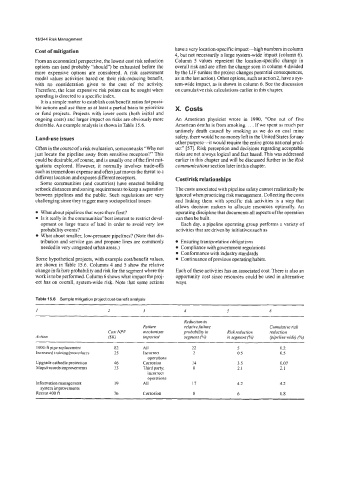
            Cost of mitigation                         have a very location-specific impact-high  numbers in column
                                                       4, but not necessarily a large system-wide impact (column 6).
            From an economical perspective, the lowest cost risk reduction   Column  5  values  represent  the  location-specific  change  in
            options can (and probably “should”) be exhausted before the   overall risk and are often the change seen in column 4 divided
            more  expensive  options  are  considered.  A  risk  assessment   by the LIF (unless the project changes potential consequences,
            model values activities based  on  their risk-reducing  benefit,   as in the last action). Other options, such as action 2, have a sys-
            with  no  consideration  given  to  the  cost  of  the  activity.   tem-wide impact, as is shown in column 6. See the discussion
            Therefore, the least expensive risk points can be sought when   on cumulative risk calculations earlier in this chapter.
            spending is directed to a specific index.
             It is a simple matter to establish costibenefit ratios for possi-
            ble actions and use them as at least a partial basis to prioritize   x. costs
            or fund projects. Projects  with  lower costs  (both  initial and
            ongoing costs) and larger impact on risks are obviously more   An  American  physicist  wrote  in  1990,  “One  out  of  five
            desirable. An example analysis is shown inTable 15.6.   American deaths is from smoking. . . . If we spent as much per
                                                       untimely  death  caused  by  smoking  as we  do on  coal  mine
            Land-use issues                            safety, there would be no money left in the United States for any
                                                       other purpose-it  would require the entire gross national prod-
            Often in the course of a risk evaluation, someone asks “Why not   uct” [57]. Risk perception and decisions regarding acceptable
           just locate the pipeline away from sensitive receptors?” This   risks are not always logical and fact based. This was addressed
            could be desirable, of course, and is usually one of the first mit-   earlier in this chapter and will be discussed further in the Risk
            igations  explored.  However, it  normally  involves trade-offs   communications section later in this chapter.
            such as tremendous expense and often just moves the threat to a
            different location and exposes different receptors.   Cost/risk relationships
             Some communities  (and  countries) have enacted building
            setback distances and zoning requirements to keep a separation   The costs associated with pipeline safety cannot realistically be
            between pipelines  and the public.  Such regulations  are very   ignored when practicing risk management. Collecting the costs
            challenging since they trigger many sociopolitical issues:   and  linking  them  with  specific risk  activities is  a  step that
                                                       allows  decision  makers  to allocate  resources  optimally, An
             What about pipelines that were there first?   operating discipline that documents all aspects of the operation
             Is it really in the communities’ best interest to restrict devel-   can then be built.
             opment on large tracts of land in order to avoid very low   Each day, a pipeline operating group performs a variety of
             probability events?                       activities that are driven by initiatives such as
             What about smaller, low-pressure pipelines? (Note that dis-
             tribution and service gas and propane lines are commonly   Ensuring transportation obligations
             needed in very congested urban areas.)     Compliance with government regulations
                                                        Conformance with industry standards
            Some hypothetical projects, with example costibenefit values,   Continuance of previous operating habits.
            are shown in Table  15.6. Columns 4 and 5  show the relative
            change in failure probability and risk for the segment where the   Each of these activities has an associated cost. There is also an
            work is to be performed. Column 6 shows what impact the proj-   opportunity cost since resources could be used in alternative
            ect has on overall, system-wide risk. Note that some actions   ways.

            Table 15.6  Sample mitigation project cost-benefit analysis

            I                     2          3           4            5            6
                                                         Reduction in
                                             Failure     relative failure          Cumulative risk
                                  Cost NP V   mechanism   probability in   Risk reduction   reduction
            dction                (W         impacted    segment (%)   in segment (%)   (pipeline wide) (%)
            1000-ft pipe replacement   82    All            22           5             0.2
            Increased traininglprocedures   25   Incorrect   2           0.5           0.5
                                              operations
            Upgrade cathodic protection   46   Corrosion    14           3.5           0.07
            Mapdrecords improvements   33    Third party;   8            2. I          2.1
                                              incorrect
                                              operations
            Information management   19      All            17           4.2           4.2
             system improvements
            Recoat 400 ft           76       Corrosion      8            6             0.8

