


Page 364 - Pipeline Risk Management Manual Ideas, Techniques, and Resources
P. 364
Risk Criteria 151339
               When the cost and effort ofmitigation measures are not dis-   Table 15.3  Acceptable risk thresholds
               proportionate to the benefits, the measures should be con-
               sidered to be practicable and should be put into effect. When   Annual chance offatalrty   Criteria
               it can be demonstrated that the cost and effort of implemen-
               tation substantially outweigh the benefit of the risk reduc-   <I  ox IO"   Insignificant, no action justifiable
               tion, then the measures are not considered to be reasonably   >I  ox 10-4   Unacceptable, action to reduce risk
                                                                          mandatory
               practicable  to  implement.  This  demonstration  should  be   1O4<Risk<  IO"   Action to reduce nsk may be warrantea
               sensitive to uncertainties  in the  risk estimates  and in the   but should be justified on a
               treatment of aversion to high-fatality accidents.          costbenefit hasis
               Once all measures  have  either been  implemented (or the
               company is committed to implementing them) or demon-   Source: Jaques, S., "NEB Risk Analysis Study, Development of  Risk
               strated to be not reasonably practicable, the risks are ALAW.   Estimation  Method," National Energy  Board of  Canada report, April
                                                        1992.
             HSE  considers  that  following  engineering  codes  and  good
             safety management practices will in general produce an instal-
             lation whose risks are tolerable, but fiuther consideration  of   In one Canadian NEB study, acceptable risk thresholds for
             practicable risk reduction measures is also necessary to show   individuals are defined as shown in Table 15.3.
             whetherrisksare ALARP [91].                 Canadian design guidelines for pipelines state that acciden-
                                                        tal loadings occurring less frequently than 1 O4  per year do not
             Examples of numerical criteria             have to be  considered.  Impact from machinery  onshore and
                                                        from vessels, anchors, trawl boards, and dropped objects are
             Although  some  examples  can  be  found  specifically  for   noted as examples of accidental loadings. In a sense, this too is
             pipelines, it is also useful to examine numerical acceptable risk   a criterion because  it implies that  from a design standpoint,
             criteria established  for land-use planning, worker safety, and   occurrences (at least the accidental type) less frequent than IO-
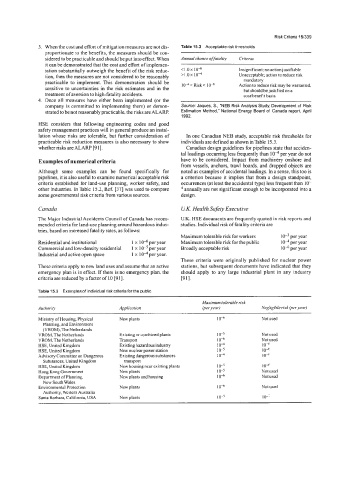
             other industries. In Table 15.2, Ref. [37] was used to compare   annually are not significant enough to be incorporated into a
             some governmental risk criteria from various sources.   design.

             Canada                                     UK. Health Safety Executive
             The Major Industrial Accidents Council of Canada has recom-   U.K. HSE documents are frequently quoted in risk reports and
             mended criteria for land-use planning around hazardous indus-   studies. Individual risk of fatality criteria are
             tries, based on increased fatality rates, as follows:
                                                        Maximum tolerable risk for workers   IO-)  per year
             Residential and institutional   1 x 1 o-6 per year   Maximum tolerable risk for the public   I o4  per year
             Commercial and low-density residential   1 x 1 0-5 per year   Broadly acceptable risk   per year
             Industrial and active open space   1 x I o4  per year.
                                                        These criteria were  originally published for nuclear power
             These criteria apply to new land uses and assume that an active   stations, but subsequent documents have indicated that they
             emergency plan is in effect. If there is no emergency plan, the   should apply to  any  large industrial plant  in  any  industry
             criteriaarereducedbyafactorof  IO [91].    [911.
             Table 15.2  Examples of individual risk criteria forthe public
                                                              Maximum tolerable risk
             AuthoriQ                Application              @er year)         Negligible risk Iperyear)
             Ministry of Housing, Physical   New plants            10-6         Not used
              Planning, and Environment
              (VROM), The Netherlands
             VROM, The Netherlands   Existing or combined plants   I 0-5        Not used
             VROM, The Netherlands   Transport                     10"          Not used
             HSE, United Kingdom     Existing hazardous industry   10-4         10"
             HSE, United Kingdom     New nuclear power station     10-5         10-6
             Advisory Committee on Dangerous   Existing dangerous substances   104   10-6
              Substances, United Kingdom   transport
             HSE, United Kingdom     New housing near existing plants   10-5    10-6
             Hnng Kong Government    New plants                    I 0-5        Not used
             Department of Planning,   New plants and housing      1 0-6        Not used
              New South Wales
             Environmental Protection   New plants                 10-6         Not used
              Authority, Western Australia
             Santa Barbara, California, USA   New plants           I 0-5        I 0-7

