


Page 370 - Pipeline Risk Management Manual Ideas, Techniques, and Resources
P. 370
costs 15/345
                Managing risk necessarily means managing costs. “Intelligent   costs. Significant risk reduction can be achieved up to a point,
               spending” practices are needed: not  spending too  much,  yet   by  increasing  expenditures.  Diminishing  returns  occur  as
               spending enough to minimize the risk. Tracking the costs of risk   further risk reductions are only available at higher and higher
               elements,  especially  risk-reducing  activities,  must  therefore   costs.
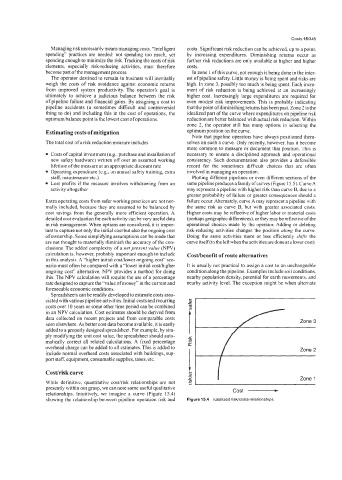
               become part of the management process.      In zone I of this curve, not enough is being done in the inter-
                The operator destined to remain in business will inevitably   est of pipeline safety. Little money is being spent and risks are
               weigh the  costs  of  risk  avoidance against  economic  returns   high. In zone 3, possibly too much is being spent. Each incre-
               from  improved  system  productivity. The  operator’s goal  is   ment  of risk  reduction  is being  achieved at  an  increasingly
               ultimately  to  achieve  a judicious balance  between  the  risk   higher  cost. Increasingly large expenditures  are required  for
               of pipeline failure and financial gains. By assigning a cost to   even modest risk  improvements. This is probably indicating
               pipeline  accidents  (a  sometimes  difficult  and  controversial   that the point of diminishing returns has been past. Zone 2 is the
               thing to do) and including this in the cost of operations, the   idealized part of the curve where expenditures on pipeline risk
               optimum balance point is the lowest cost of operations.   reduction are better balanced with actual risk reduction. Within
                                                          zone  2, the  operator  still has many  options  in  selecting the
               Estimating costs of mitigation             optimumposition on the curve.
                                                           Note that pipeline operators have always positioned them-
               The total cost of a risk reduction measure includes   selves on such a curve. Only recently, however, has it become
                                                          more common to measure or document that position. This is
                Costs of capital investment (e.g.. purchase and installation of   necessary  to  ensure  a  disciplined  approach  and  operational
                new safety hardware) written off over an assumed working   consistency. Such documentation  also provides a  defensible
                lifetime of the measure at an appropriate discount rate   record  for  the  sometimes  difficult  choices  that  are  often
                Operating expenditure (e.g., on annual safety training, extra   involved in managing an operation.
                staff, maintenance etc.)                   Plotting different pipelines or even different sections of the
                Lost profits  if the measure  involves withdrawing from an   same pipeline produces a family of curves (Figure 15.5). Curve A
                activity altogether                       may represent a pipeline with higher risk than curve B, due to a
                                                          greater probability of failure or greater consequences should a
               Extra operating costs from safer working practices are not nor-   failure occur. Alternately, curve A may represent a pipeline with
               mally included, because they are assumed to be balanced by   the  same risk as curve  B,  but  with  greater associated costs.
               cost  savings from the  generally  more efficient  operation. A   Higher costs may be reflective of higher labor or material costs
               detailed cost evaluation for each activity can be very useful data   (perhaps geographic differences),  or they may be reflective of the
               in risk management. When options are considered, it is impor-   operational choices made by  the operator. Adding or deleting
               tant to capture not only the initial cost but also the ongoing cost   risk-reducing activities changes the position along  the curve.
               of ownership. Some simplifying assumptions can be made that   Doing the  same  activities more  or  less  efficiently sh$s  the
               are not thought to materially diminish the accuracy of the con-   curve itself (to the lei? when the activities are done at a lower cost).
               clusions. The added complexity of a netpresent value (NPV)
               calculation is, however, probably important enough to include   Costlbenefit of route alternatives
               in this analysis. A “higher initial cost/lower ongoing cost” sce-
               nario must often be compared with a “lower initial codhigher   It is usually not practical to assign a cost to an unchangeable
               ongoing cost” alternative. NPV provides a method for doing   condition along the pipeline. Examples include soil conditions,
               this. The NPV calculation will require the use of a percentage   nearby population density, potential for earth movements. and
               rate designed to capture the “value of money” in the current and   nearby activity level. The exception might be when  alternate
               foreseeable economic conditions.
                Spreadsheets can be readdy developed to estimate costs asso-
               ciated with various pipeline activities. Initial costs and recurring
               costs over 10 years or some other time period can be combined
               in an NPV calculation. Cost estimates should be derived from   7
               data collected on  recent projects  and from comparable costs
               seen elsewhere.  As better cost data become available, it is easily          Zone  3
               added to a properly designed spreadsheet. For example, by sim-
               ply modifying the unit cost value, the spreadsheet should auto-
               matically correct  all  related calculations. A  fixed percentage
               overhead charge can be added to all estimates. This is added to              Zone 2
               include normal overhead costs associated with buildings, sup-
               port staff, equipment, consumable supplies, taxes, etc.
               Cost/risk curve
                                                                                            Zone 1
               While  definitive,  quantitative  cosdrisk relationships  are not   cost -
               presently within our grasp, we can note some useful qualitative
               relationships.  Intuitively, we  imagine  a  curve  (Figure  15.4)
               showing the relationship between pipeline operation risk and   Figure 15.4  Idealized risklcosts relationships.

