


Page 372 - Pipeline Risk Management Manual Ideas, Techniques, and Resources
P. 372
costs 151347
                                                          pay, looks at how much an individual is willing to pay (in terms
                                                          of other goods and services given up) to gain a reduction in the
                                                          probability of accidental death (again, a statistical death, not
                                                          the individual’s). Each method has its drawbacks and benefits.
                                                           Human capital approaches. These estimate the value of life
                                                           in terms of the future economic output that is lost when a per-
               Minimum                                     son is killed. This may be in terms of gross output (in effect,
               Expected Cost -                             the lifetime salary) or net output (in effect, the lifetime tax
                                                           payments). This narrow economic approach is now largely
                                                           discredited, because it is recognized that people value life for
                                                           its own sake rather than for its capacity to maintain economic
                                                           output.
                                   Optimal Risk    Risk    Willingness-to-pay approaches. These estimate the amount
                                                           that people in society would be prepared to pay to avoid a sta-
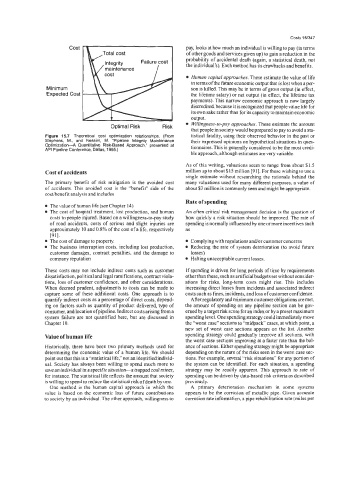
               Figure  15.7  Theoretical  cost  optimization  relationships.  (From   tistical fatality, using their observed behavior in the past or
               Stephens,  M.,  and  Nessim,  M.  “Pipeline Integrity  Maintenance   their expressed opinions on hypothetical situations in ques-
               Optimization-A  Quantitative Risk-Based  Approach,” presented  at   tionnaires. This is generally considered to be the most credi-
               API  Pipeline Conference, Dallas, 1995.)
                                                           ble approach, although estimates are very variable.
                                                          As of this writing, valuations seem to range from about $1.5
               Cost of accidents                          million up to about $15 million [9 11. For those wishing to use a
                                                          single estimate without  researching the rationale  behind  the
               The primary  benefit  of risk  mitigation  is the  avoided  cost   many valuations used for many different purposes, a value of
               of  accidents. This avoided  cost  is  the  ‘‘benefit’’  side of the   about $3 million is commonly seen and might be appropriate.
               costibenefit analysis and includes
                                                          Rate of spending
                The value of human life (see Chapter 14)
                The cost of hospital treatment, lost production, and human   An often critical risk management decision is the question of
                costs to people injured. Based on a willingness-to-pay study   how quickly a risk situation should be improved. The rate of
                of  road  accidents,  costs  of  serious  and  slight injuries  are   spending is normally influenced by one or more incentives such
                approximately 10 and 0.8% of the cost of a life, respectively   as
                ~911.
                The cost of damage to property.            Complying with regulations andor customer concerns
                The business  interruption costs, including lost production,   0  Reducing the rate of system deterioration (to avoid  future
                customer  damages,  contract penalties,  and  the  damage  to   losses)
                company reputation                         Halting unacceptable current losses.
               These costs may  not  include indirect costs such as customer   If spending is driven for long periods of time by requirements
               dissatisfaction, political and legal ramifications, contract viola-   other than these, such as artificial budgets set without consider-
               tions, loss of customer confidence, and other considerations.   ations  for  risks,  long-term  costs  might  rise.  This  includes
               When deemed prudent,  adjustments to costs can be made to   increasing direct losses from incidents and associated indirect
               capture  some of these  additional  costs. One  approach  is  to   costs such as fines, incidents, and loss of customer confidence.
               quantify indirect costs as a percentage of direct costs, depend-   After regulatory and minimum customer obligations are met,
               ing on factors such as quantity of product delivered, type of   the amount of spending on any pipeline section can be gov-
               consumer, and location ofpipeline. Indirect costs arising from a   erned by a target risk score for an index or by a preset maximum
               system  failure  are not  quantified  here, but  are discussed  in   spending level. One spending strategy could immediately move
               Chapter IO.                                the “worst case” sections to “midpack’ cases, at which point, a
                                                          new  set of  worst case  sections  appears  on  the list. Another
               Value of human life                        spending strategy could gradually improve ail sections, with
                                                          the worst case sections improving at a faster rate than the bal-
               Historically, there  have  been  two primary  methods  used  for   ance of sections. Either spending strategy might be appropriate
               determining the economic value of a human life. We  should   depending on the nature of the risks seen in the worst case sec-
               point out that this is a “statistical life,” not an identified individ-   tions. For example, several “risk situations” for any portion of
               ual. Society has always been willing to spend much more to   the system can be  identified.  For  each  situation, a spending
               save an individual in a specific situation-a  trapped coal miner,   strategy  may  be  readily  apparent.  This  approach  to  rate  of
               for instance. The statistical life reflects the amount that society   spending can be driven by data-based risk criteria as described
               is willing to spend to reduce the statistical risk of death by one.   previously.
                One  method  is  the  human capital  approach  in which  the   A  primary  deterioration  mechanism  in  some  systems
               value  is based  on  the economic  loss of future contributions   appears to be the corrosion  of metallic pipe. Given accurate
               to society by an individual. The other approach, willingness to   corrosion rate information, a pipe rehabilitation rate (miles per

