


Page 373 - Pipeline Risk Management Manual Ideas, Techniques, and Resources
P. 373
15/348 Risk Management
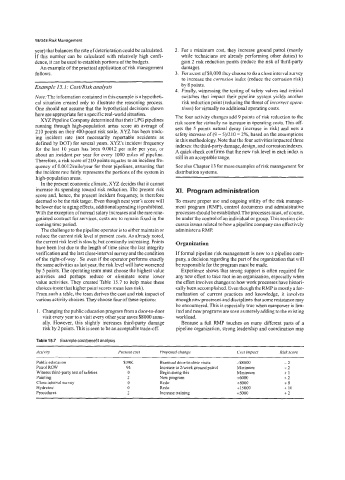
            year) that balances the rate of deterioration could be calculated.   For a minimum cost, they increase ground patrol (mostly
            If this number  can be calculated  with relatively high  confi-   while technicians are already  performing  other duties) to
            dence. it can be used to establish portions ofthe budgets.   gain 2 risk reduction points (reduce the risk of third-party
             An example of the practical application of risk management   damage).
            follows.                                     For a cost of $8,000 they choose to do a close interval survey
                                                         to increase the corrosion index (reduce the corrosion risk)
            Example 15.1: Cost/Riskanalysis              by 8 points.
                                                         Finally, witnessing the testing of safety valves and critical
            Note: The information contained in this example is a hypotheti-   switches that  impact their pipeline  system yields another
            cal situation created only to illustrate the reasoning process.   risk reduction point (reducing the threat of incorrect operu-
            One should not assume that the hypothetical decisions shown   tions) for virtually no additional operating costs.
            here are appropriate for a specific real-world situation.   The four activity changes add 9 points of risk reduction to the
             XYZ Pipeline Company determined that their LPG pipelines
            running  through  high-population  areas score  an  average  of   risk score for virtually no increase in operating costs. This off-
                                                       sets the  5  points  natural  decay (increase in risk) and nets  a
            210 points on their 400-point risk scale. XYZ has been track-   safety increase of (9 - 5)/210 = 2%, based on the assumptions
            ing  incident  rate  (not  necessarily  reportable  accidents  as   in this methodology. Note that the four activities impacted three
            defined by DOT) for several years. XYZ’s incident frequency   indexes: the third-party damage, design, and corrosion indexes.
            for the last  10 years has  been  0.0012 per  mile  per year,  or   A quick check confirms that the new risk level in each index is
            about  an incident per year  for every  1000 miles of pipeline.   still in an acceptable range.
            Therefore, a risk score of 210 points equates to an incident fre-
            quency of 0.0012/mile/year for these pipelines, assuming that   See also Chapter 13 for more examples ofrisk management for
            the incident rate fairly represents the portions of the system in   distribution systems.
            high-population areas.
              In the present economic climate, XYZ decides that it cannot
            increase its spending toward risk reduction. The present risk   XI.  Program administration
            score and, hence, the present incident frequency, is therefore
            deemed to be the risk target. Even though next year’s score will   To ensure proper use and ongoing utility of the risk rnanage-
            be lower due to aging effects, additional spending is prohibited.   ment program (RMP), control documents and administrative
            With the exception of normal salary increases and the rare rene-   processes should be established. The processes must, of course,
            gotiated contract for services, costs are to remain fixed in the   be under the control of an individual or group. This section dis-
            coming time period.                        cusses issues related to how a pipeline company can effectively
              The challenge to the pipeline operator is to either maintain or   administer a RMP.
            reduce the current risk level at present costs. As already noted,
            the current risk level is slowly, but constantly increasing. Points   Organization
            have been lost due to the length of time since the last integrity
            verification and the last close-interval survey and the condition   If formal pipeline risk management is new to a pipeline com-
            of the right-of-way . So even if the operator performs exactly   pany, a decision regarding the part of the organization that will
            the same activities as last year, the risk level will have worsened   be responsible for the program must be made.
            by 5 points. The operating team must choose the highest value   Experience shows that strong support is often required for
            activities  and  perhaps  reduce  or  eliminate  some  lower   any new effort to take root in an organization, especially when
            value activities. They created Table  15.7 to help make these   the effort involves changes to how work processes have histori-
            choices (note that higher point scores mean less risk).   cally been accomplished. Even though the RMP is mostly a for-
            From such a table, the team derives the cost and risk impact of   malization  of  current  practices  and  knowledge,  it  involves
            various activity choices. They choose four ofthese options:   enough new processes and disciplines that some resistance may
                                                       be encountered. This is especially true when manpower is lim-
            1.  Changing the public education program from a door-to-door   ited and new programs are seen as merely adding to the existing
              visit every year to a visit every other year saves $8000 annu-   workload.
              ally.  However,  this  slightly  increases  third-party  damage   Because a full RMP touches on many  different parts of a
              risk by 2 points. This is seen to be an acceptable trade-off.   pipeline organization, strong leadership and coordination may

            Table 15.7  Example cosvbenefit analysis
            Activiry                 Present cost   Proposed change       cost impact   Riskscore
            Public education           $39K       Biannual door-to-door visits   -$SO00   -2
            Patrol ROW                  94        increase to 2lweek ground patrol   Minimum   +2
            Witness third-party test ofsafeties   0   Begin doing this    Minimum       +1
            Painting                    2         New program             +6000         +2
            Close interval survey       0         Redo                    +so00         +S
            Hydrotest                   0         Redo                    +1sooo        + 10
            Procedures                  2         Increase training       +so00         +2

