


Page 371 - Pipeline Risk Management Manual Ideas, Techniques, and Resources
P. 371
15/36 Risk Management
             L,                                       variables. A costirisk mathematical relationship can be theo-
                                                      rized for each mitigation activity. For most management deci-
                                                      sions, this relationship need not be highly precise. The user is
                                                       usually interested in  comparing the cost of equivalent risk-
                                                       reducing alternatives. When costs of alternatives are close, fur-
                                                       ther refinement of costs may be required; however, the costs
                                                      of many of the possible options will be orders of magnitude
                                                      dfferent.
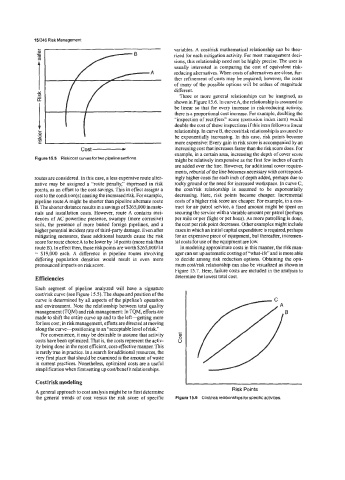
                                                        Three  or  more  general relationships can be imagined, as
                                                       shown in Figure 15.6. In curve A, the relationship is assumed to
                                                       be linear so that for every increase in risk-reducing activity,
                                                       there is a proportional cost increase. For example, doubling the
                                                       “inspection of rectifiers” score (corrosion index item) would
                                                       double the cost of those inspections if this item follows a linear
                          cost -                       be exponentially increasing. In this case, risk points become
                                                       relationship. In curve B, the cost‘risk relationship is assumed to
                                                       more expensive: Every gain in risk score is accompanied by an
                                                       increasing cost that increases faster than the risk score does. For
                                                       example, in a certain area, increasing the depth of cover score
            Figure 15.5  Risklcost curves for two pipeline sections.   might be relatively inexpensive as the first few inches of earth
                                                       are added over the line. However, for additional cover require-
                                                       ments, reburial of the line becomes necessary with correspond-
            routes are considered. In this case, a less expensive route alter-   ingly higher costs for each inch of depth added, perhaps due to
            native  may be  assigned a  “route penalty,”  expressed in risk   rocky ground or the need for increased workspace. In curve C,
            points, as an offset to the cost savings. This in effect assigns a   the  cost‘risk  relationship  is  assumed  to  be  exponentially
            cost to the condition(s) causing the increased  risk. For example,   decreasing. Here,  risk  points  become  cheaper:  Incremental
            pipeline route A might be shorter than pipeline alternate route   costs of a higher risk score are cheaper. For example, in a con-
            B. The shorter distance results in a savings of $265,000 in mate-   tract for air patrol service, a fixed amount might be spent on
            rials and installation costs.  However,  route A  contains inci-   securing the service with a variable amount per patrol (perhaps
            dences of AC powerline presence, swampy (more corrosive)   per mile or per flight or per hour). As more patrolling is done,
            soils, the  presence of  more buried foreign pipelines, and  a   the cost per risk point decreases. Other examples might include
            higher potential incident rate of third-party damage. Even after   cases in which an initial capital expenditure is required, perhaps
            mitigating measures, these additional hazards cause the risk   for an expensive piece of equipment, but thereafter, incremen-
            score for route choice  A to be lower by 14 points (more risk than   tal costs for use of the equipment are low.
            route B). In effect then, those risk points are worth $265,000/14   In modeling approximate costs in this manner, the risk man-
            = $19,000  each. A  difference  in  pipeline  routes  involving   ager can set up automatic costing of “what-ifs” and is more able
            differing  population  densities  would  result  in  even  more   to decide among risk reduction options. Obtaining the opti-
            pronounced impacts on risk score.          mum cost‘risk relationship can also be visualized as shown in
                                                       Figure 15.7. Here, failure costs are included in the analysis to
            Efficiencies                               determine the lowest total cost.
            Each  segment  of  pipeline  analyzed  will  have  a  signature
            costirisk curve (see Figure 15.5). The shape and position of the
            curve is determined by all aspects of the pipeline’s operation
            and environment. Note the relationship between total quality
            management (TQM) and riskmanagement: InTQM, efforts are
            made to shift the entire curve up and to the left-getting  more
            for less cost; in risk management, efforts are directed at moving
            along the curve-positioning  to an “acceptable level of risk.”
              For convenience, it may be desirable to assume that activity
            costs have been optimized. That is, the costs represent the activ-
            ity being done in the most efficient, cost-effective manner. This
            is rarely trve in practice. In a search for additional resources, the
            very first place that should be examined is the amount of waste
            in current practices. Nonetheless, optimized costs are a useful
            simplification when first setting up costhenefit relationships.

            Costkisk modeling                             I
                                                                        Risk Points
            A general approach to cost analysis might be to first determine
            the  general trends of cost versus the risk  score  of  specific   Figure 15.6  CosWrisk relationships for specific activities.

