


Page 182 - Plant design and economics for chemical engineers
P. 182
PLANT DESIGN AND ECONOMICS FOR CHEMICAL ENGINEERS


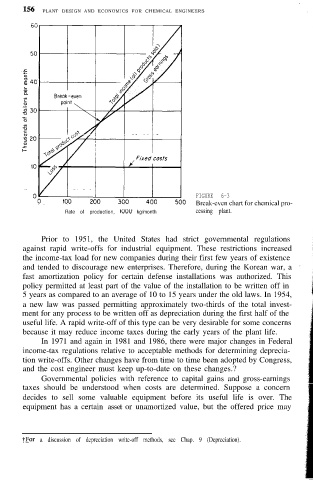
                                                   FIGURE  6-3
                                                   Break-even chart for chemical pro-
                  Rate  of  production,  1000  kg/month  cessing plant.


            Prior to 1951, the United States had strict governmental regulations
       against rapid write-offs for industrial equipment. These restrictions increased
       the income-tax load for new companies during their first few years of existence
       and tended to discourage new enterprises. Therefore, during the Korean war, a
       fast amortization policy for certain defense installations was authorized. This
       policy permitted at least part of the value of the installation to be written off in
       5 years as compared to an average of 10 to 15 years under the old laws. In 1954,
       a new law was passed permitting approximately two-thirds of the total invest-
       ment for any process to be written off as depreciation during the first half of the
       useful life. A rapid write-off of this type can be very desirable for some concerns
       because it may reduce income taxes during the early years of the plant life.
            In 1971 and again in 1981 and 1986, there were major changes in Federal
       income-tax regulations relative to acceptable methods for determining deprecia-
       tion write-offs. Other changes have from time to time been adopted by Congress,
       and the cost engineer must keep up-to-date on these changes.?
            Governmental policies with reference to capital gains and gross-earnings
       taxes should be understood when costs are determined. Suppose a concern
       decides to sell some valuable equipment before its useful life is over. The
       equipment has a certain asset or unamortized value, but the offered price may


       tFor  a discussion of depreciation write-off methods, see Chap. 9 (Depreciation).

