


Page 198 - Plant-Based Remediation Processes
P. 198
190 A. Branzini and M.S. Zubillaga
riparian forests, soil erosion control, and rehabilitation of degraded areas (Pott and
Pott 1994). However, the level of accumulation of heavy metals differs between and
within species (McGrath et al. 2002). That is why local remediation studies are
important.
In a previous study, we found that S. virgata is capable of germinating and
growing under heavy metal stress (Branzini and Zubillaga 2010). As a conse-
quence, and because S. virgata is a pioneer species with rapid growth, we found
interest in assessing the tolerance behavior of S. virgata (Vilela de Resende et al.
2000). In addition, in order to assess the tolerance behavior of S. virgata, the
absorption, translocation, and growth performance of S. virgata in response to
interactions between copper, zinc, and chromium in binary mixtures were evaluated
(Branzini et al. 2012). In a pot experiment, heavy metals were added to soil (Typic
Hapludoll) either individually or in binary mixture solutions of Cu, Zn, and Cr, in
1
low or high doses (Low: Cu ¼ 60, Zn ¼ 125, and Cr ¼ 50 (mg kg ); High:
1
Cu ¼ 700, Zn ¼ 1,050, and Cr ¼ 116 (mg kg )). This enrichment corresponds
to the maximum levels of total HM that occur in the Pampas region (Llosa et al.
1990; Lavado et al. 1998; Giuffre ´ et al. 2005). The S. virgata plants were allocated
into 13 treatments as follows, and at harvest (30 days), plants were carefully
removed and washed with deionized water to remove any attached particles. The
heavy metal transfer from a contaminated soil to plants and into plant tissues is
discussed in terms of the Bioconcentration Factor (BCF) and the Transfer Factor
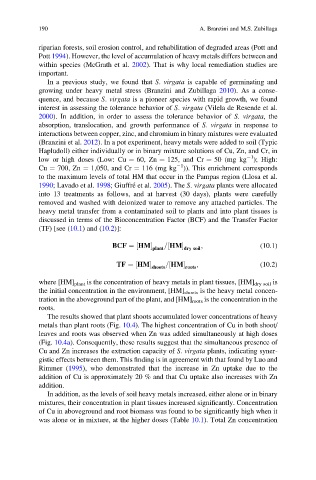
(TF) [see (10.1) and (10.2)]:
½
BCF ¼ HM = HM ; (10.1)
½
plant dry soil
½
TF ¼ HM = HM ; (10.2)
½
shoots roots
where [HM] plant is the concentration of heavy metals in plant tissues, [HM] dry soil is
the initial concentration in the environment, [HM] shoots is the heavy metal concen-
tration in the aboveground part of the plant, and [HM] roots is the concentration in the
roots.
The results showed that plant shoots accumulated lower concentrations of heavy
metals than plant roots (Fig. 10.4). The highest concentration of Cu in both shoot/
leaves and roots was observed when Zn was added simultaneously at high doses
(Fig. 10.4a). Consequently, these results suggest that the simultaneous presence of
Cu and Zn increases the extraction capacity of S. virgata plants, indicating syner-
gistic effects between them. This finding is in agreement with that found by Luo and
Rimmer (1995), who demonstrated that the increase in Zn uptake due to the
addition of Cu is approximately 20 % and that Cu uptake also increases with Zn
addition.
In addition, as the levels of soil heavy metals increased, either alone or in binary
mixtures, their concentration in plant tissues increased significantly. Concentration
of Cu in aboveground and root biomass was found to be significantly high when it
was alone or in mixture, at the higher doses (Table 10.1). Total Zn concentration

