


Page 149 - Practical Control Engineering a Guide for Engineers, Managers, and Practitioners
P. 149
124  Chapter  Five

                The last line shows that the denominator of G is a third-order
             polynomial in s results, so the system is indeed a third-order sys-
             tem. Equation (5-4) also shows that the transfer function G has three
             poles at

                                          1
                                                1
                                    1
                                s=--:z:-,  --:r-,   t:3
                                     1     2
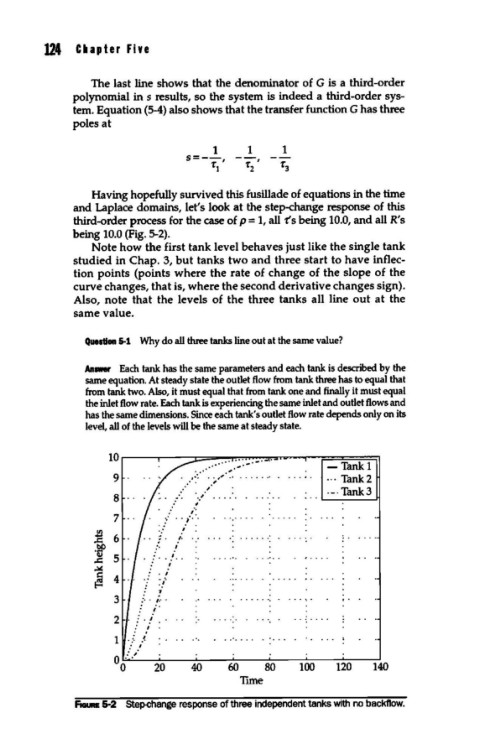
                Having hopefully survived this fusillade of equations in the time
             and Laplace domains, let's look at the step-change response of this
             third-order process for the case of p =  1, all ts  being 10.0, and all R's
             being 10.0 (Fig. 5-2).
                Note how the first tank level behaves just like the single tank
             studied in Chap. 3, but tanks two and three start to have inflec-
             tion points (points where the rate of change of the slope of the
             curve changes, that is, where the second derivative changes sign).
             Also,  note  that the  levels  of the three  tanks all  line out at the
             same value.

               Question S-1  Why do all three tanks line out at the same value?

               Anawer  Each tank has the same parameters and each tank is described by the
               same equation. At steady state the outlet flow from tank three has to equal that
               from tank two. Also, it must equal that from tank one and finally it must equal
               the inlet flow rate. Each tank is experiencing the same inlet and outlet flows and
               has the same dimensions. Since each tank's outlet flow rate depends only on its
               level, all of the levels will be the same at steady state.

                   lOr----.----~~~~~~~~-.======~
                                    ···   ·;::..-·     -Tank 1
                    9            .~:···0  0  ,,<.   0   0   0   0   0   0.   0   ...  Tank 2
                               oo'o   0   ,.,
                    8         _:0   ·o,;   0   0   0   0   0   0   0   0   0   0   0   °- Tank 3
                                                         0
                                 "
                    7       o,   0   0) 0  /:  0   0   0   0   0   0   0   0   0   0   0   0   0   0
                           00   ;   0
                 ~  6      :0  /    ....  · ......  ·  .
                                              0
                                        0
                 .!l!P     ,'o   01
                           0
                 .!  5   0   :  0   0   .'  ..
                 ~        ,'   I
                         /  ~/
                 ~  4
                    3    ..  :  0   ,:  ..
                        0:  i  0
                    2   : 0  j       ... ·.·  ...  ·.
                       :'  i
                    1  0..:'  /
                       o   I
                      ...  ;
                    0  0.
                     0     20    40    60    80    100   120   140
                                         Tune
             FIGURE 5-2  Step-change response of three independent tanks with no backflow.

