


Page 150 - Practical Control Engineering a Guide for Engineers, Managers, and Practitioners
P. 150
Matrices  and  Higher-Order  Process  Models   125


             The Frequency Domain Version
             As we have done for all our example processes, let's move on to the
             frequency domain. Since we know that a single tank exhibits amplitude
             attenuation and phase lag with increasing  frequency,  what do you
             expect with this process? The tanks are in  series. The input to the second
             and third tanks is the output from the first and second tanks, respec-
             tively, so, the amplitude attenuation and phase increase should  be accu-
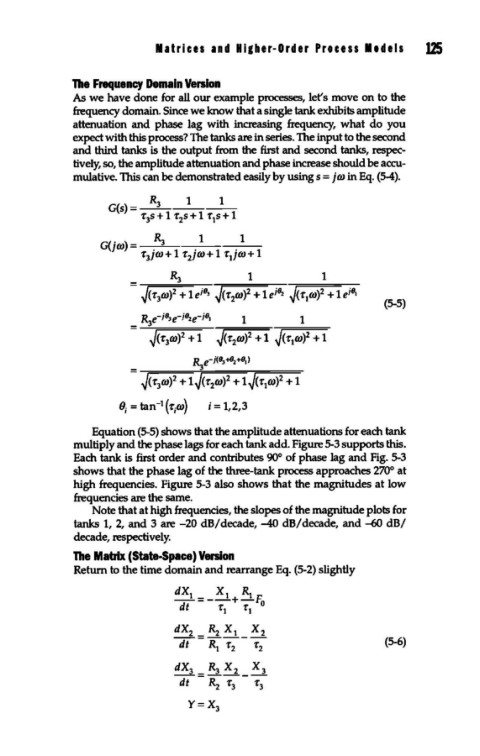
             mulative. This can be demonstrated easily by using s =  jm in Eq. (5-4).
                          R 3   1    1
                   G(s) = -r s + 1 -r s + 1 -r s + 1
                         3     2    1
                  G("m)=   R3     1      1
                   1
                        -r jm + 1 -r jm + 1 -r jm  + 1
                         3      2      1
                             R 3          1           1
                       =1?==~~~·-r==~==~-~==~==~
                        ~(-r3m)2 + 1  eiB3  ~(-r2m)2 + 1 ei~ ~(-rtm)2 + 1  eiB,
                                                                 (5-5)
                                8
                        ~e-ifl,e-i 2e-i ,   1      1
                                   8
                       -  ~(-r3m)2 + 1  ~(-r2m)2 + 1  ~(-rtm)2 + 1
                       _         ~e-i<B,~+B1 )
                       - ~(-r3m)2 + 1~(-r2m)2 + 1~{-rtm)2 + 1

                            1
                     9;  = tan- (-r;m)   i = 1,2,3
                Equation (5-5) shows that the amplitude attenuations for each tank
             multiply and the phase lags for each tank add. Figure 5-3 supports this.
             Each tank is first order and contributes 90° of phase lag and Fig. 5-3
             shows that the phase lag of the three-tank process approaches 270° at
             high frequencies. Figure 5-3 also shows that the magnitudes at low
             frequencies are the same.
                Note that at high frequencies, the slopes of the magnitude plots for
             tanks 1, 2,  and 3 are -20 dB/  decade, -40 dB/  decade, and -60 dB/
             decade, respectively.
             The Matrix (State-Space) Version
             Return to the time domain and rearrange Eq. (5-2) slightly
                              dX 1  =-~+~F.
                               dt    t't   t't  0

                              dX 2   _  ~  X  1   X  2
                              dt- R ~-~                          (5-6)
                                     1
                              dX 3  _  ~  x  2   X  3
                              dt-~  ~-~

                                Y=X  3

