


Page 158 - Practical Control Engineering a Guide for Engineers, Managers, and Practitioners
P. 158
Matrices  and  Higher-Order  Process  Models   133


             The State-Space Version
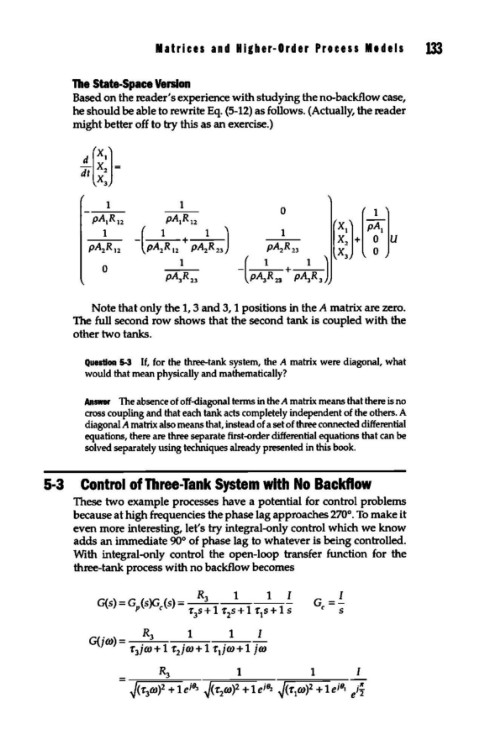
             Based on the reader's experience with studying the no-backflow case,
             he should be able to rewrite Eq. (5-12) as follows. (Actually, the reader
             might better off to try this as an exercise.)

              .!!...(~·]=
                  2
              dt
                 x3
                   1           1
                pA•R12       PA1Rt2
                  1    -(p~R  12  + p~RJ
                p~Rt2
                               1
                  0
                             pA3R23
                Note that only the 1, 3 and 3, 1 positions in the A matrix are zero.
             The full second row shows that the second tank is coupled with the
             other two tanks.

               Question 5-3  If, for the three-tank system, the A matrix were diagonal, what
               would that mean physically and mathematically?

               Answer  The absence of off-diagonal terms in the A matrix means that there is no
               cross coupling and that each tank acts completely independent of the others. A
               diagonal A matrix also means that, instead of a set of three connected differential
               equations, there are three separate first-order differential equations that can be
               solved separately using techniques already presented in this book.


        5-3  Control of Three-Tank System with No Backflow
             These two example processes have a potential for control problems
             because at high frequencies the phase lag approaches 270°. To make it
             even more interesting, let's try integral-only control which we know
             adds an immediate 90° of phase lag to whatever is being controlled.
             With  integral-only  control  the  open-loop  transfer function  for  the
             three-tank process with no backflow becomes

                                  R 3   1    1   I       I
                 G(s) = G (s)G (s) = -------         G  =-
                        P   c   ~s+1~s+l~s+1s         c   5
                                 3     2    1

