


Page 159 - Practical Control Engineering a Guide for Engineers, Managers, and Practitioners
P. 159
134  Chapter  Five


                       -         ~e -i(B3+B2+811)    I
                            3  2     2  2    1  2
                       - ~(-r ro) + 1~(-r ro) + 1~(-r ro) + 1  m


                                                                (5-14)

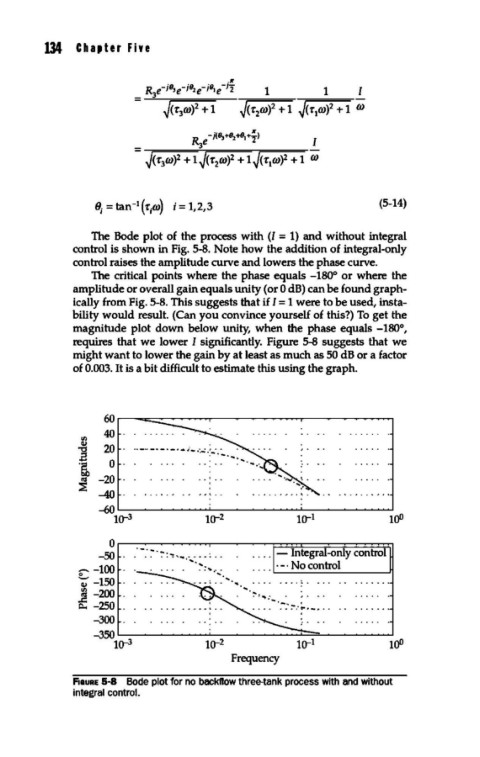
                The Bode plot of the process with (I= 1)  and without integral
             control is shown in Fig. 5-8. Note how the addition of integral-only
             control raises the amplitude curve and lowers the phase curve.
                The critical points where the phase equals -180° or where the
             amplitude or overall gain equals unity (or 0 dB) can be found graph-
             ically from Fig. 5-8. This suggests that if I= 1 were to be used, insta-
             bility would result. (Can you convince yourself of this?) To get the
             magnitude plot down below unity,  when the phase equals -180°,
             requires  that we lower I  significantly.  Figure 5-8  suggests that we
             might want to lower the gain by at least as much as 50 dB or a factor
             of 0.003. It is a bit difficult to estimate this using the graph.


                  40
              II)
              ]   20   ··-·· -· -·- .... i- .·,.: ·:-··:.. ... ,
              ·~   0
                                  .. • ..
              ~  -20
                 -40


                   Or-~--~--~~~~--~~t=~~~~~~~
                                  ·
                 -50       ·-:-:-: ,.,. .· .. · ... .. : . .   . ... - Integral-only control
              --100               ........ ·   ·- · No control
              ~ -150
              .!  -200
              c..  -250
                -300
                -350~~~~~~~--~~~~~~=-~~~~~
                    1~             1~             ~              ~
                                       Frequency
             F1auRE 5-8  Bode plot for no backflow three-tank process with and without
             integral control.

