


Page 163 - Practical Control Engineering a Guide for Engineers, Managers, and Practitioners
P. 163
138  Chapter  Five


                  1.4 r-----r-~-~~----r--~-r---;:::::t:=::::::J::::::==::::;-J
                  1.2
                   1
              "'0  0.8       ·.
               ;   0.6
              V)  0.4
                  0.2                                    :   ;
                   00   50   100  150  200  250  300  350  400  450  500


                 ~: ~~ (\.  ;  .... ·> .  . .       ·.
                  o.1  t  . ·V-·  -.--.---------------i
              :::s  0.08
                 0.06
                 0.04
                 0.02
                   0
                    0   50   100  150  200  250  300  350  400  450  500
                                         Tune
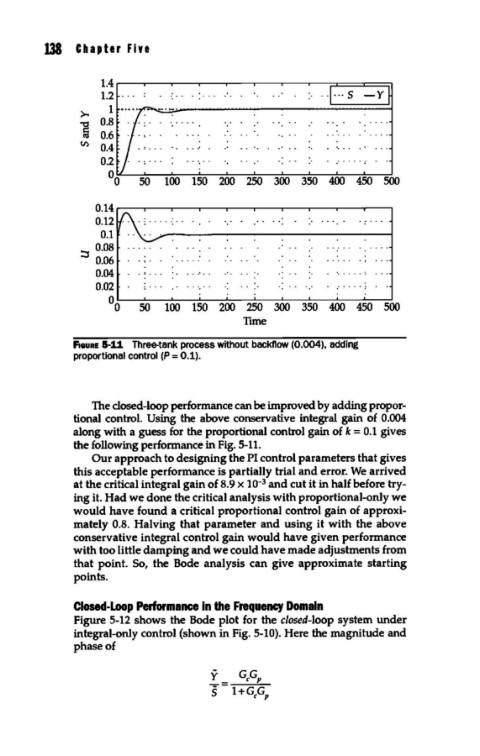
             F•auRE 5·11  Thre~tank  process without backflow (0.004), adding
             proportional control (P = 0.1).


                The closed-loop performance can be improved by adding propor-
             tional control.  Using the above conservative integral gain of 0.004
             along with a guess for the proportional control gain of k = 0.1 gives
             the following performance in Fig. 5-11.
                Our approach to designing the PI control parameters that gives
             this acceptable performance is partially trial and error. We arrived
                                            3
             at the critical integral gain of 8.9 x 10- and cut it in half before try-
             ing it. Had we done the critical analysis with proportional-only we
             would have found a critical proportional control gain of approxi-
             mately 0.8.  Halving that parameter and using it with the above
             conservative integral control gain would have given performance
             with too little damping and we could have made adjustments from
             that point. So,  the  Bode  analysis can give approximate  starting
             points.

             Closed-Loop Performance In the Frequency Domain
             Figure 5-12 shows the Bode plot for  the closed-loop system under
             integral-only control (shown in Fig. 5-10). Here the magnitude and
             phase of

                                    y    GcGp
                                    S- 1+GcGp

