


Page 168 - Practical Control Engineering a Guide for Engineers, Managers, and Practitioners
P. 168
Matrices  and  High e r-0 rd e r  Process  Models   143


                    0
              ~   -20     .. ..   . . ... . .
              :2.
              .,   -40
               cu
              .a                                   0
              :.::1   -60   .. . :   . . . .. ..   ........ · .
               c..
              ~   -80                               Q
                  -100
                            1Q-2     to-1      100      10 1     1o2
                    0
                                                        -FOWDT
                                                         o  N-Tanker
              - -150           ..........
              ~
               ~
               tU
              f  -1000       i.    ... ·,·
                 -1500         ...........                 . .  . .......
                            1o-2     1Q-1      100      101      1o2
                                       Frequency (Hz)

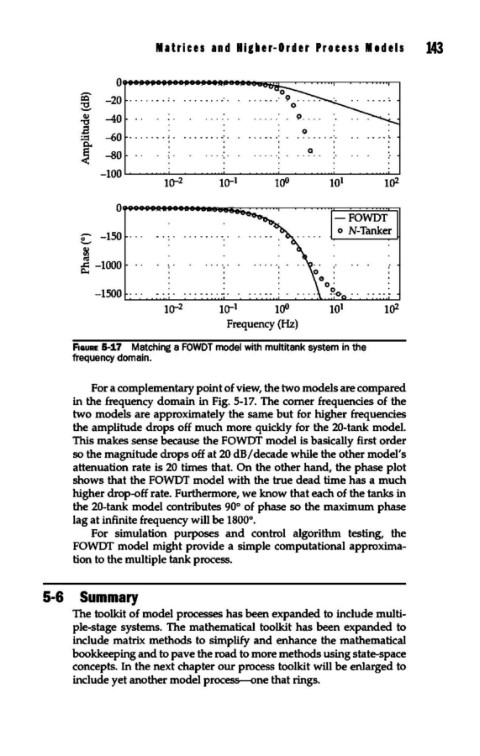
             F1auRE 5-17  Matching a FOWDT model with multitank system in the
             frequency domain.

                For a complementary point of view, the two models are compared
             in the frequency domain in Fig. 5-17. The comer frequencies of the
             two models are approximately the same but for higher frequencies
             the amplitude drops off much more quickly for the 20-tank model.
             This makes sense because the FOWDT model is basically first order
             so the magnitude drops off at 20 dB/decade while the other model's
             attenuation rate is 20 times that. On the other hand, the phase plot
             shows that the FOWDT model with the true dead time has a much
             higher drop-off rate. Furthermore, we know that each of the tanks in
             the 20-tank model contributes 90° of phase so the maximum phase
             lag at infinite frequency will be 1800°.
                For  simulation  purposes  and  control  algorithm  testing,  the
             FOWDT model might provide a simple computational approxima-
             tion to the multiple tank process.

        5-6  Summary
             The toolkit of model processes has been expanded to include multi-
             ple-stage systems. The mathematical toolkit has been expanded to
             include matrix methods to simplify and enhance the mathematical
             bookkeeping and to pave the road to more methods using state-space
             concepts. In the next chapter our process toolkit will be enlarged to
             include yet another model process-one that rings.

