


Page 165 - Practical Control Engineering a Guide for Engineers, Managers, and Practitioners
P. 165
140  C h a p t e r  F iY e


             where the dependence on the critical radian frequency m, is shown.
             (Note that Eq.  (5-17) is a consequence of the expression el = -1 that
                                                            11
             we mentioned in App. B). Actually, Eq. (5-17) depends on both m, and
             the critical control gain k, (if the control is proportional-only). If the
             control is integral-only then the critical control gain would be 1,. Since
             Eq.  (5-17) is now a complex equation, there are real and imaginary
             parts.  Therefore,  there  are  two  equations  in  the  two  unknowns,
             m,  and k,.  This argument suggests  that the  pole-finding approach
             and the Bode plot approach are basically the same.


        5-5  Multitank Processes
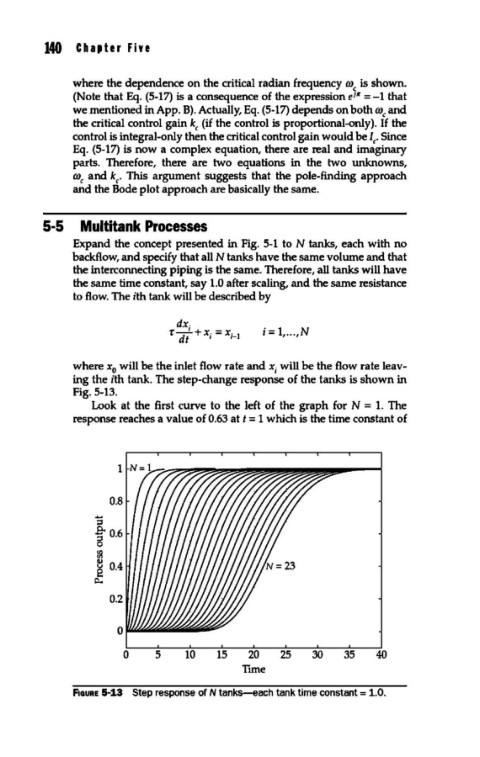
             Expand the concept presented in Fig.  5-1  toN tanks, each with no
             backflow, and specify that all N tanks have the same volume and that
             the interconnecting piping is the same. Therefore, all tanks will have
             the same time constant, say 1.0 after scaling, and the same resistance
             to flow. The ith tank will be described by

                              dx.
                             r-' +x. =x.    i = 1, ... ,N
                               dt   I   1- 1
             where x will be the inlet flow rate and X; will be the flow rate leav-
                    0
             ing the ith tank. The step-change response of the tanks is shown in
             Fig. 5-13.
                Look at the  first curve to  the left of the graph for  N  = 1.  The
             response reaches a value of 0.63 at t = 1 which is the time constant of


                    1


                   0.8
                 "5
                 ~0.6
                 0
                 ~
                 ~ 0.4
                 p..
                   0.2


                     0     5    10   15   20   25    30   35   40
                                         Ttme
             F1auRE 5-13  Step response of N tanks-each tank time constant = 1.0.

