


Page 170 - Practical Control Engineering a Guide for Engineers, Managers, and Practitioners
P. 170
CHAPTER 6


                                     An Underdamped


                                                      Process


        6-1  The Dynamics of the Mass/Spring{Dashpot Process
             All  of the example  processes  mentioned  so  far  have  been  "over-
             damped" in that the open-loop step response does not generate over-
             shoot or oscillations of any kind. The first-order process really has no
             choice-its behavior is dictated by its gain and time constant. The
             three  tank  third-order  process  has  an inflection  point in the step
             response but it will never oscillate or "ring" when subjected to a step
             change in the process input with no feedback control. These over-
             damped processes are typical of most of the real-live industrial pro-
             cesses that I faced for most of my career. However, near the end I got
             involved in some new photonics processes that were underdamped
             and posed many new challenges.
                When we close the control loop on the overdamped processes we
             could get underdamped and even unstable behavior when the feed-
             back was aggressive but the processes by themselves could not exhibit
             this kind of performance.
                Not so with the so-called mass/ spring/ dash pot process shown in
             Fig. 6-1. To derive an equation that describes its behavior one needs
             to apply Newton's second law of motion:


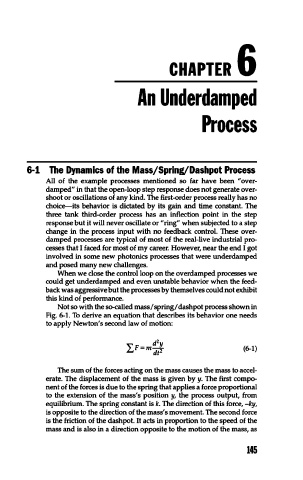
                                                                 (6-1)


                The sum of the forces acting on the mass causes the mass to accel-
             erate. The displacement of the mass is given by y. The first compo-
             nent of the forces is due to the spring that applies a force proportional
             to the extension of the mass's position y,  the process output, from
             equilibrium. The spring constant is k. The direction of this force, -ky,
             is opposite to the direction of the mass's movement. The second force
             is the friction of the dashpot. It acts in proportion to the speed of the
             mass and is also in a direction opposite to the motion of the mass, as

                                                                  145

