


Page 171 - Practical Control Engineering a Guide for Engineers, Managers, and Practitioners
P. 171
146  C  h  a  p  t  e  r S  ix

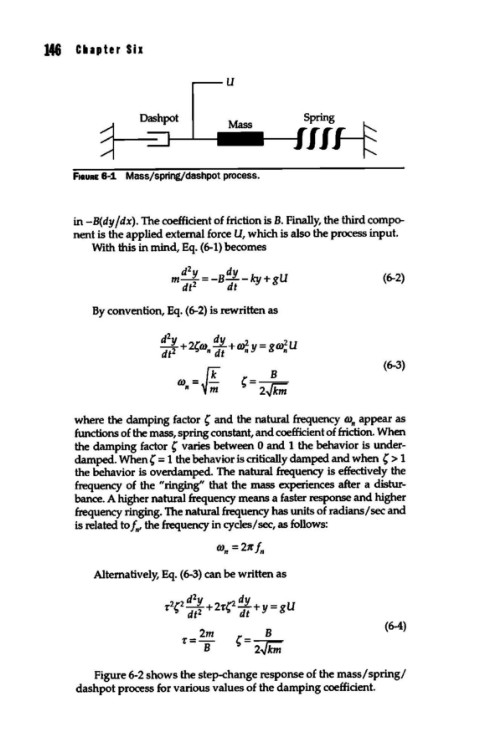
                                       u


                        Dashpot


             F1auRE 6-1  Massjspring,tdashpot process.


             in -B(dy  Jdx). The coefficient of friction is B. Finally, the third compo-
             nent is the applied external force U, which is also the process input.
                With this in mind, Eq. (6-1) becomes

                                2
                               d y     dy
                              m dt2  = -8-;u- ky + gU            (6-2)
                By convention, Eq. (6-2) is rewritten as

                            d2y      dy     -   2
                            di2  +  2{co, dt+  ~  y- gco, U
                               co=  rr        B                  (6-3)
                                " vm     {= 2Ji(m


             where the damping factor {  and the natural frequency  C0 appear as
                                                            11
             functions of  the mass, spring constant, and coefficient of friction. When
             the damping factor {  varies between 0 and 1 the behavior is under-
             damped. When { =  1 the behavior is critically damped and when { > 1
             the behavior is overdamped. The natural frequency is effectively the
             frequency of the "ringing'' that the mass experiences after a distur-
             bance. A higher natural frequency means a faster response and higher
             frequency ringing. The natural frequency has units of radians/  sec and
             is related to  f,, the frequency in cycles/  sec, as follows:

                                     co"= 21r /,
                 Alternatively, Eq. (  6-3) can be written as


                                                                 (6-4)
                                  2m         B
                               T=-      {= 2Ji;i
                                   8
                 Figure 6-2 shows the step-change response of the mass/spring/
              dashpot process for various values of the damping coefficient.

