


Page 172 - Practical Control Engineering a Guide for Engineers, Managers, and Practitioners
P. 172
A  n U  n  d  e  r  d  a  m  p  e  d P  ro c  e  s  s  147


                                        Time
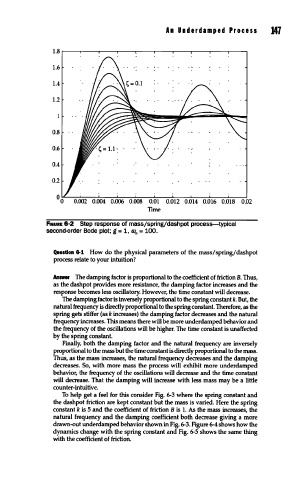
             F1auRE 6-2  Step response of massjspringjdashpot process-typical
             second-order Bode plot; g =  1, ron =  100.


               Question  6-1  How do the physical parameters of the mass/spring/dashpot
               process relate to your intuition?

               Answer  The damping factor is proportional to the coefficient of friction B. Thus,
               as the dashpot provides more resistance, the damping factor increases and the
               response becomes less oscillatory. However, the time constant will decrease.
                 The damping factor is inversely proportional to the spring constant k. But, the
               natural frequency is directly proportional to the spring constant. Therefore, as the
               spring gets stiffer (ask increases) the damping factor decreases and the natural
               frequency increases. This means there will be more underdamped behavior and
               the frequency of the oscillations will be higher. The time constant is unaffected
               by the spring constant.
                 FinaUy, both the damping factor and the natural frequency are inversely
               proportional to the mass but the time constant is directly proportional to the mass.
               Thus, as the mass increases, the natural frequency decreases and the damping
               decreases. So, with more mass the process will exhibit more underdamped
               behavior, the frequency of the oscillations will decrease and the time constant
               will decrease. That the damping will increase with less mass may be a  little
               counter-intuitive.
                 To help get a feel  for this consider Fig. 6-3 where the spring constant and
               the dashpot friction are kept constant but the mass is varied. Here the spring
               constant k is 5 and the coefficient of friction B is 1. As the mass increases, the
               natural frequency and the damping coefficient both decrease giving a  more
               drawn-out underdamped behavior shown in Fig. 6-3. Figure 6-4 shows how the
               dynamics change with the spring constant and Fig. 6-5 shows the same thing
               with the coefficient of friction.

